
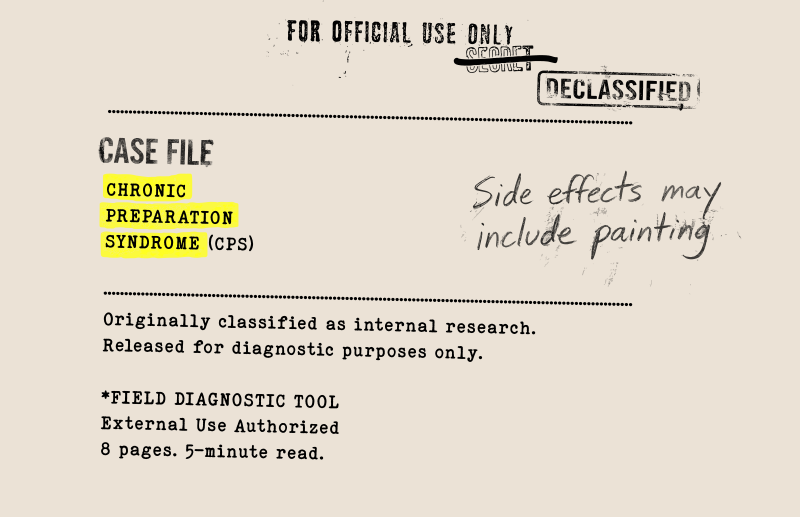


CHRONIC
PREPARATION
SYNDROME (CPS)
Originally classified as internal research.
Released for diagnostic purposes only.
**FIELD DIAGNOSTIC TOOL
External Use Authorized
8 pages. 5-minute read.
Classification:

C.G. — Head of Quarantine Research
Lazaretto Island Research Facility — Internal Doc.
CASE nº1. Patient E.H.
.................................
E.H. wrote the way one plans the perfect crime.
He read everything. Observed everything. Hoarded facts, gestures, references, moments. He built an enormous warehouse of material that nobody would ever see. Seven-eighths of the iceberg stayed underwater.
Not gone. Just holding the text up from below.
Here's the remarkable bit: he betrayed all of it. Never showed it off. He let it work from underneath, quietly, as though everything he knew could only function when he wasn't looking.
Leave out something you know, and the text breathes. Leave out something you don't know, and the text dies. The reader can't tell what's missing. But they feel it.
.................................
CLINICAL NOTE:
E.H. displayed every symptom of compulsive accumulation consistent with CHRONIC PREPARATION SYNDROME (hereafter CPS). However, he executed with strategic amnesia. Material entered, submerged, and operated without conscious supervision. He turned the symptom into a method.
OBSERVATIONS:
Ernest Hemingway won the Nobel Prize in Literature.
CASE nº2. Patient C.G.
.................................

This patient does something similar. Reads, observes, collects things, fills himself with images, phrases, scenes, details. Everything goes in, everything is welcome. Then he plans the work as if it were the perfect crime.
And then, when he sits down to paint, he does the exact opposite and humiliates all those plans. Improvises over whatever he remembers of them.
The patient calls this cultural bulimia. He gorges on culture and then vomits a painting that bears no resemblance whatsoever to what he'd planned. What comes out is better than the plan.
Because the plan was a clock, and the painting is time.
.................................
CLINICAL NOTE:
Patient C.G. presents the same accumulation pattern as E.H. The clinical difference lies not in how much he accumulates but in what happens next. C.G. systematically betrays the accumulated material. The adverse symptom becomes the solution.
OBSERVATIONS:
Suspicious, but functional.
Built an art cult on a private island.
SECTION 2 — SYMPTOMATOLOGY
.................................
CPS manifests in progressive phases. The patient is rarely aware of the transition from one to the next.
*Phase 1 — Accumulation. The patient studies composition before composing, learns anatomy before drawing, reads about light before painting it. This phase feels like rigor. Like high standards. Like doing things properly. It feels like virtue.
*Phase 2 — Escalation. Each completed course opens the door to the next. Each closed book reveals everything the patient has yet to master. The gap between what they know and what they do widens.
*Phase 3 — Translation. When the patient finally paints, they don't paint. They translate. They attempt to transfer the perfect idea in their head into the language of paint. The translation always loses something. The result never matches the idea, and they find this intolerable.
*Phase 4 — Loop. The patient resolves that they need more study. This conclusion feels like intelligence, like humility, like healthy self-criticism. It is a loop. Each lap takes the patient one step further from the work they've been postponing for years.
Standard diagnosis: CPS positive. Compulsive accumulation of training. Systematic avoidance of execution. Panic toward risk and loss of control. High levels of satisfaction during study that vanish upon contact with canvas. Patient reports feeling "nearly ready" on a chronic basis.
SECTION 3 — ETIOLOGY
.................................
Academia is a sandbox. Useful. Safe. Controlled.
Outside it lies the real world, with all its density, its unsettling honesty, and its capacity for surprise.
CPS patients tend to remain in the sandbox. Not because they lack the qualifications to leave — they're absurdly overqualified. They stay because inside they can control the outcome.
Investigator's note: A painting does not communicate an idea. It IS an idea. It works like a perfume: the evocations don't travel inside it. It merely sets them off. Having a perfect plan before painting is like writing a script for what a perfume should make you feel. You can write the most meticulous script in the world. The perfume will do whatever it bloody well pleases inside each nose.
.................................
One mustn't confuse clocks with time. Nor the study of painting with painting. They're as different as reading about water and getting wet.
SECTION 4 — TREATMENT PROTOCOL
.................................
Ref: Field experiments #1–6, Lazaretto Island
(X) Contraindication: discontinuing study worsens the condition. The treatment is not to study less.
(0) Optimal protocol. No relapse. No side effects:
REVERSE THE ORDER
Before Stanislavski, theater worked as follows: the actor read the text, understood it, memorized it, and then attempted to act. Fix first. Live later.
Stanislavski turned it around. The actor first creates an atmosphere, an impulse, a gesture, then enters the scene with the body before the head. Emotion appears as a consequence of action, not the other way round. The script is memorized last, once it has become the sediment of something actually lived.
The system trusts life to produce memory.
CPS runs on the old theater sequence applied to painting. Idea first, then control, then correct execution. Result: correct and dead.
Emotions are not transmitted efficiently or inefficiently. They are transmitted, or they are not. Those born of control are not transmitted at all.
The patient concludes they need a better script. But precision was never the problem. The order was the problem.
Field results: this protocol is actively tested on Lazaretto Island. Artists placed in situations where atmosphere precedes the plan, gesture precedes the idea, and the body moves before the head can. The script is worked on after the creative act, once the emotional atmosphere has been embodied. Six experiments. Hundreds of artists from 30+ countries. Consistent unblocking in 98% of subjects.
.................................
The knowledge accumulated was not acquired in vain. It is the entire iceberg. It's down there, holding up the tip. Always has been. It simply needs to sit a bit lower, make room at the top for what matters: act, do, paint. That comes first. Always.
Then reflect on what has been done.
Never the other way round.
.................................
Investigator's note: E.H. didn't write in spite of what he knew. He wrote because he knew it and could afford to forget it.

SECTION 5 — PROGNOSIS
.................................
Classification:

Field log. Direct observation.
The patient sits before the canvas. No plan. Stomach tightens. The mind scrambles for something to hold on to. A reference. A procedure. Something safe.
There is nothing.
And then the hand moves. Before she does. HALLELUJAH.
A mark she hadn't planned. That mark demands another. That one leads somewhere she hadn't foreseen. And suddenly she's inside something alive. Something she couldn't have thought up. Something that could only appear like this: without permission, without a map, without a script.
The iceberg was supporting from below. As it always should have been.

Investigator's note: the reader of this file has just studied a classified document about the addiction to studying. And is probably already wondering what to read next.
**Knowing was never the problem. Not having the nerve to keep what you know to yourself —that was.***
That little voice saying "but I just need to learn a bit more before I…" → That's the symptom.
And the patient accepts it because, to her, the symptom is the goal.

SECTION 6 — ACTIVE PROTOCOL FOR AFFECTED PATIENTS
.................................
Patients diagnosed with CPS who do not respond to autonomous order reversal (Section 4) have access to a supervised experimental protocol at the Lazaretto Island facility.
Quarantine Experiment #8
October 12–18, 2027. Lazaretto Island. 7 days. 7 mentors. 63 artists.
Admission is curated. Phones are prohibited. The program is secret.
The protocol is classified.
Some patients achieve remission on their own.
For the rest of us who aren't Hemingway, there's a week on an island.
.................................

