Give this guide to an artist who's feeling stuck.
For painters good enough to doubt themselves. This guide won't cure impostor syndrome; nothing does. It shows why it grows with your talent, why the artists you admire live with it every day, and how to stop it from deciding what you paint.
I Lied to You
I lied to you, twice. Check it out:
Lie #1 – This is not a "guide"; it's an appetizer of Quarantine, our in-person program: seven days on a quarantine island in Menorca. It's something of a perfume sample, just for you to test on (and under) your skin.
At the end, I'll remind you that this is part of something bigger and I'll try to convince you to come to the island.
Lie #2 – This is going to break your heart, but you must know that you'll never overcome Impostor Syndrome. It doesn't go away, and you'll see why. I used this title just to catch your attention, and here you are. It worked. I must be a genius.
Let me explain.
You won't get over it because you need it, and it serves an important purpose. You'll understand its nature, integrate it into your creative process, and learn to manage it to your advantage. Hey, not so bad.
Put differently, you'll still have Impostor Syndrome, but it will no longer hinder you. And, in time, you'll watch it pass by, like a drifting cloud.
After this rough start, I promise no more lies.
Two more things before we get started:
This guide is designed to cut to the chase and not waste your time.
I won't disrespect you with nonsense like "follow these four simple steps, and this will go away," or "be your best self."
We're going to question some beliefs. We'll do it in depth, and sometimes it'll hurt. At some points, you'll love me, and sometimes you'll hate me for the same reasons.
This is not a rehash of other books or courses. It's home grown. We don't deal in hearsay.
Don't be fooled by the price. The information you'll find here is of high value and the result of direct observation. No theories or mental clutter.
This concentrates eight years of experiments with hundreds of artists, and I'll only give you what we've proven works.
This guide is so strange that you might even finish it. If you're an artist with low confidence, it's good to read it at least once in your life.
Have a great day,
Carles Gomila.
Menorca. September 2024.
#MeToo: The Painters You Admire Feel Like Frauds Too
In this lesson, I'll reveal three secrets that will probably change your perspective.
If you're reading this, it's because you're hurt.
We all suffer from it...
That feeling of being a fraud, thinking you don't deserve what you've achieved, that at any moment the truth will come out. That if something went well, it was just luck, and you wouldn't be able to repeat it without getting lucky again.
This is the famous Imposter Syndrome, and we all feel it in the darkest corner of our minds.
But don't get carried away by trendy labels, because this is as old as humanity itself and an inescapable part of the creative process.
So I've got good news and bad news.
First the bad news: if a creative doesn't suffer from Imposter Syndrome, they're not creative. They're something else.
If you don't feel like a fraud, that's a bad sign, a symptom that the Muses aren't on your side. You might be a psychopath or a fool. But not a creative.
I'm not joking about the psychopath part.
And now for the good news.
Well, it's not 100% good, but it's good enough, you'll see. I'd give it a solid pass.
Here it is:
"The greatest artists are the ones who suffer from this syndrome the most intensely."
Said like that, it sounds almost comforting.
All those great artists you admire so much also feel like frauds. Let me tell you…
Henrik Uldalen
Henrik Uldalen is a simple, strong, humble man. He dresses in white but his soul is dark as wine. He always smiles but keeps one eye on death; a majestic, beautiful, creative death. A vital death.
I remember a conversation I had with Henrik when I asked him about the shift in his new work and congratulated him on his recent exhibition.
He smiled, but there was pain in his heart, and this is exactly what he told me:
"The exhibition was a success, sales went really well. The gallery is very pleased, but I'm not so much. I wish it had gone badly. When something I want to change goes well, it's a problem. I don't want to paint like this anymore, but they'll keep asking for more of the same.
After the exhibition, I felt empty and lost for months. For half a year, I couldn't paint; I was sunk. I wandered about my studio, tidying up, cleaning, but doing nothing.
It took me a long time to find myself again, and I started experimenting with new ideas and materials. I didn't know what I was doing, or if the galleries would accept it.
I eventually managed to paint a small collection that seems to be taking the right direction. We'll see…"
This wasn't the first time Henrik had taken a risk. Some years ago, he was known for his realism. His galleries and collectors expected more and better realism from him, and things were going well as such.
But Henrik changed. He started over. He took a gamble.
And now you might think that someone like him must have nerves of steel and confidence far beyond possibly feeling like a fraud. But no: Henrik did what he did despite feeling terrified and helpless.
It's what we call in Quarantine being a "brave coward." He did it with fear, accepting uncertainty and the responsibility to fail.
Edward Povey, Vincent Desiderio, Lita Cabellut, Phil Hale
Edward Povey also confessed to me that he spends hours in the studio, doubting, drinking tea, muttering, indefinitely postponing getting down to his painting. He told me this with a smile on his face and utter naturalness, as if it were the most normal thing in the world. As if it were part of his work routine, something inevitable, necessary.
Zero drama.
And now hold onto your hat, because Edward told me that "painting is not his strong suit." He was completely serious.
Can you believe it? Edward Povey, that man who paints like the gods, says painting isn't his strong suit. And he said it without hesitation, with total honesty.
It's crazy. The man says painting "is not his strong suit."
But I believe him.
Vincent Desiderio told me there are moments when he feels terrified, lost, and bored with himself. Moments when he can't stand himself and doubts everything. Moments when he wants to throw it all away. And that those moments happen daily.
Lita Cabellut confessed that she's shy and fragile, that the feeling of doubt is permanent, and she's learned to live with it.
Phil Hale told me he didn't know what he was doing, and he was just trying things to see if they worked... Phil quit painting several times and spent years without it. In the meantime, he tried music and motorcycle design.
You get it?
You surely get it…
Because we all go through the same thing.
But don't relax just yet; there's still a lot of work to do.
Look, at Quarantine we don't deal in hearsay. We distrust mental clutter, and our approach is empirical. So our method for gathering high-value information is… drinking beer with great artists.
Haha, it's true!
And I assure you that not one of these geniuses isn't (at the very least) as messed up as you are. They're all scared, feel helpless, and don't know what they're doing.
They all feel insignificant and are tempted to give it all up at any moment because they see themselves as frauds.
We've talked about this with our mentors at length. Every single one of them is convinced they have no idea what they're doing.
They all -EVERY SINGLE ONE OF THEM, I say- admit suffering from Imposter Syndrome.
But that's not the end of it. They suffer from it to the extreme, at its highest intensity.
Enormously. As much as their art is great. Their work is light years ahead of any amateur's, and their Imposter Syndrome is just as extraordinary.
They go hand in hand.
Because Imposter Syndrome is proportional to the artist's talent. I've never met an exception.
They see themselves as small, insignificant, fraudulent. And the more amazing their art is, the more amazing their inferiority complexes are.
So why wouldn't it happen to you too? You're not that special. It would be extremely arrogant to think this doesn't affect you when it affects the best. You didn't think you were immune, did you?
We're all broken inside, and the only difference between a broken person and one that isn't is that the latter hides it well and believes it's worth accepting the pain.
I'll talk more about that later.
Besides, I think you're ready to handle the first big revelation…
First Revelation: Impostor Syndrome is Universal.
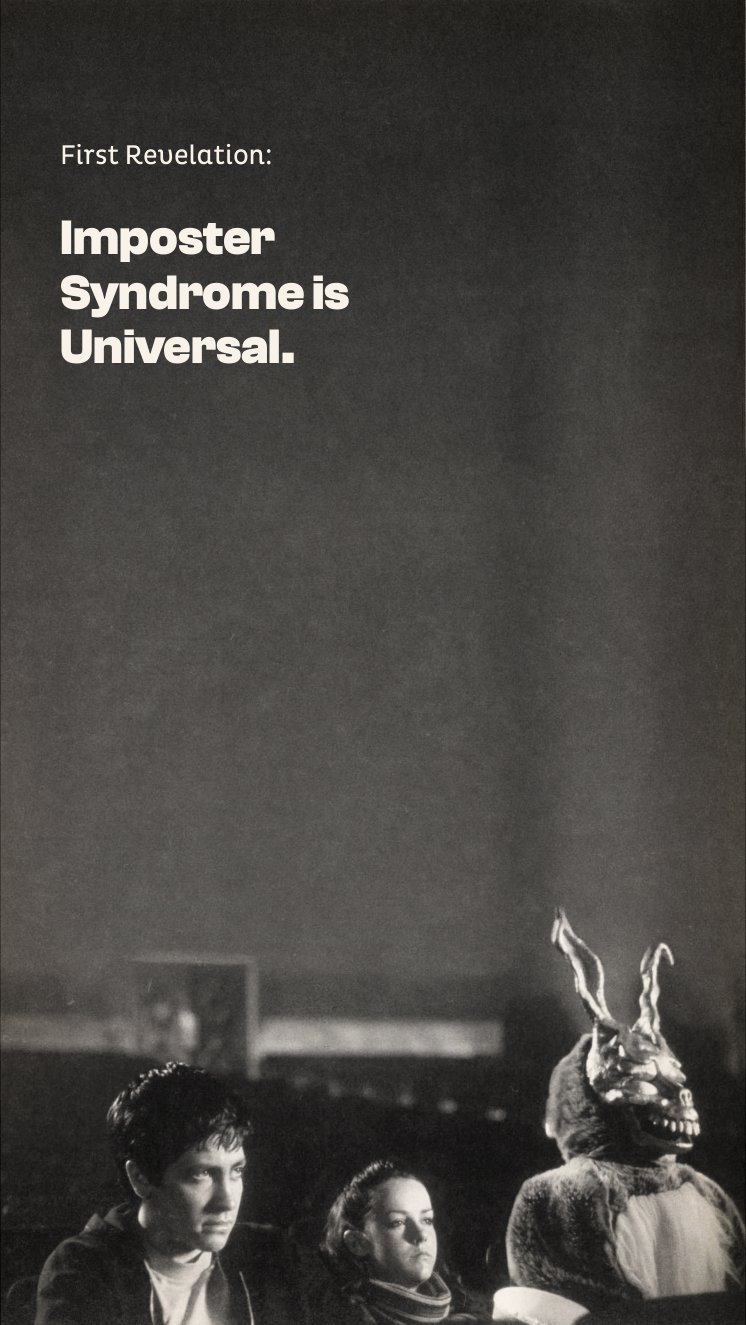
Who do you think you are to think you'll escape Impostor Syndrome?
Nobody who's good at something avoids this mental trap because it clings to excellence like a shadow to light. You can't be good at something without feeling, at the same time, like you're faking it.
That's just how it is.
Everyone is broken inside, terrified, feeling small. It's part of the deal. Imposter Syndrome and excellence are not opposites; you can't have one without the other. They are the same movement. The same creature.
Things are as they are in comparison to something else. And Imposter Syndrome is no exception. It's the shadow of a light, and the darker the shadow, the more powerful the light that casts it. If you want light, you must accept the shadow.
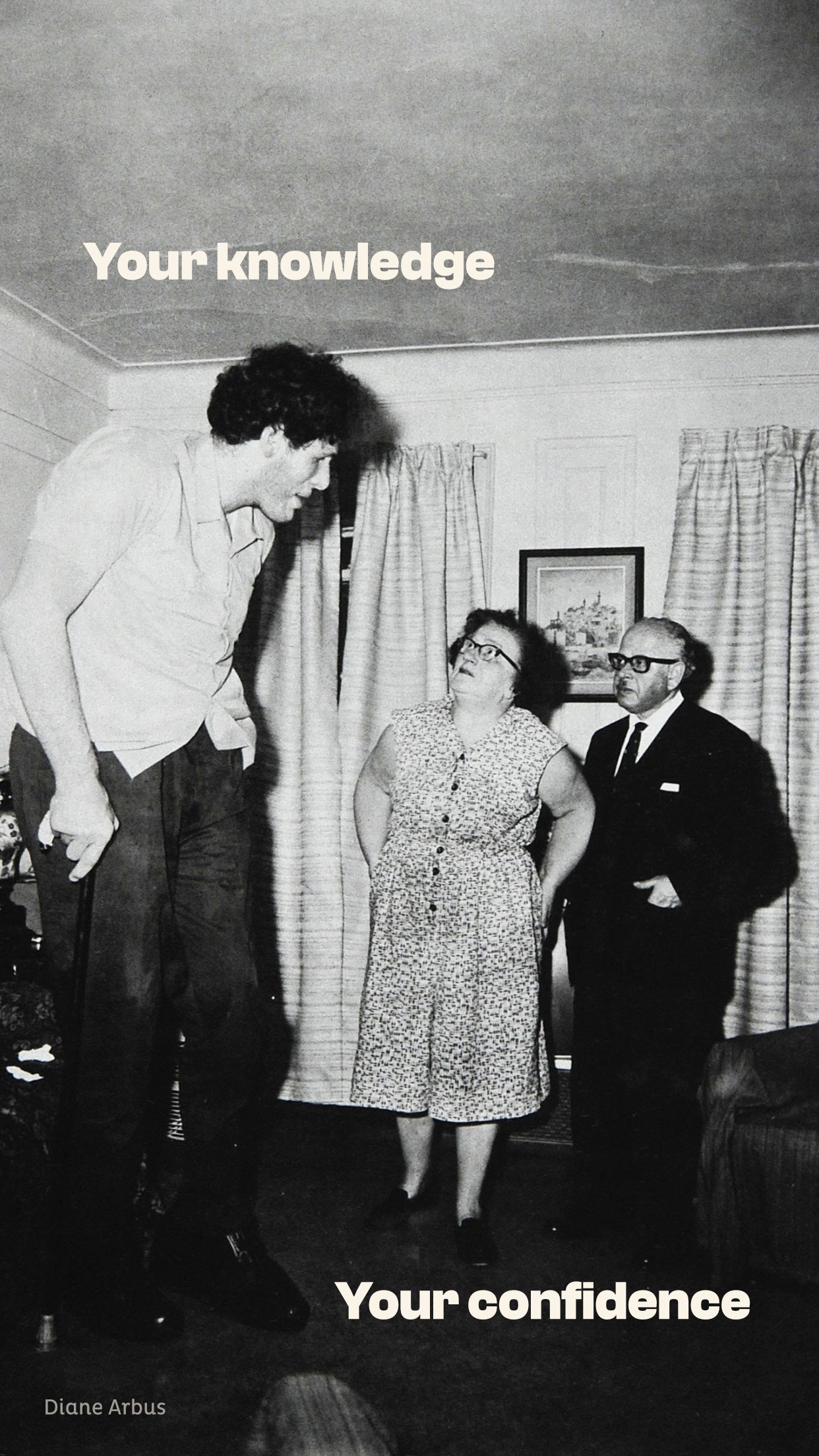
Confidence is an illusion. The reality is that knowledge always comes with doubt. If you know nothing, you have no doubt. But if you know a lot, you realize how much you still don't know.
Only someone who truly understands feels like a fraud, as they're aware of their own short-comings. It's so obvious that we overlook it.
Knowing your weak points is a sign that you've got a good map of the terrain in your head. Without knowledge, there's no doubt. It can't exist. Clear as day.
You're ready for the second revelation…
Second Revelation: Impostor Syndrome is inseparable from knowledge.
You'll keep hearing that voice telling you you're not enough. Why? Because creating something worthwhile means taking risks. You can't hide behind safe formulas. When you do something new, when you create, you inevitably feel vulnerable. And that vulnerability will always be accompanied by doubt.
Creating means exposing yourself to uncertainty.
This is where things get interesting. Because if you feel like a fraud, it's because you're doing something new and encountering resistance to the pain.
Imposter Syndrome is the side effect of doing something real; it doesn't just show up for no reason. Three conditions must be met:
- Knowledge
- Ability
- Challenge
It doesn't emerge because you're bad at what you do; it happens because you care and have prepared for it. Imposter Syndrome indicates that you're pushing boundaries, challenging what you know, trying to do something that has the power to change your perception.
When there's no challenge, there's no Imposter Syndrome. And the greater the challenge, the larger that shadow of doubt that accompanies the action.
It's natural to question whether you really have what it takes.
But beware, if you're not feeling any of this, you're in dead territory —in routine mode, without pain or pressure. And, of course, without progress either.
What's interesting is that this doubt, this internal voice, is the best sign that you're on the right path. And your whole being will resist because it's designed to test you.
Imposter Syndrome is not a stumbling block in the road that can be avoided; it is the road itself. You're not special for feeling it. Nor are you a victim of circumstances. You must accept that voice as part of the process. It's your ally. I mean it, you need it.
I don't know any artist, not a single one, who has overcome it. They all accept it and integrate it as part of the inevitable —though painful— process in an artist's life.
Lita Cabellut, in her mentorships at Quarantine, emphasized this quite a bit. She said:
"I'm not going to help you get over this pain. This pain isn't something you'll ever overcome. You'll have to live with it, and thanks to it, you'll become a great artist."
So the more progress you make as a person and as an artist, the wiser and more experienced you grow… the more intense and crushing the feeling will be that you know nothing, that you're insignificant, that you're small, that you're nobody, that you have no ideas.
Creativity is a process that breathes: there's continuous movement between doubt and inspiration that keeps us from stagnating. You must learn to breathe well and accept both inhalation and exhalation equally, without drama.
So stop wasting energy thinking you're going to overcome it. There's no cure, no therapy, no magic formula. If you want to be a true artist, you'll have to learn to live with these demons and make a pact with them.
Impostor Syndrome isn't something you overcome; it's something you accept and use as a compass.
You're going to have to live with these demons your entire life.
It won't go away. I'm sorry.
You are those demons, and without them, there's no art.
But a day will come when you stop thinking about them, and you won't care anymore. You'll have made peace with them, and there will be a relative, tolerable, healthy, creative peace.
Now listen closely.
Every time that feeling of worthlessness strikes you, get ready. Because after that contraction comes the expansion, that moment when everything flows, and you create freely. And when the demon comes back to whisper, "this is trash, you're worthless," it will be another sign that you're exactly where you need to be: doing something despite that damn little voice.
The infallible sign that you're breathing and not stuck.
So if you're there, amidst creation, feeling like an impostor, it's because you're truly immersed in a creative process and facing the most painful phase.
Insecurity and courage are as intertwined as light and shadow. And no one can have light without accepting the shadow. Think of it this way: the light that shines the brightest is the one that casts the darkest shadows. And the closer you get to that light, the longer the shadow being cast.
It's a cruel and non-negotiable paradox, but necessary.
And now we reach the heart of the matter. Because the more you grow as an artist, the stronger that feeling becomes. It's not a weakness; it's a symptom of your progress.
It's a symptom of strength.
The greatest artists, those who truly leave a mark, are the ones who suffer from it the most. No matter how many achievements they accumulate, how many rounds of applause they receive, there will always be a part of them that feels like they're fooling everyone.
If you feel like an impostor, you're not failing. You're on the right track. Stay there, hold on. Because the higher you climb, the stronger the pull downward…
Third and Final Revelation: You feel like more of an impostor the more valuable you are.
Does it sound counterintuitive? It sounds counterintuitive.
The truth always strolls in with a paradox under its arm.
Insecurity is a sign that you're bringing value.
When you feel that way, what do you do? Stop? Give up? No way. You grab it by the horns and keep moving forward. Because if your legs aren't shaking, it means you're playing it safe. And safe is worth nothing.
Embrace the Paradox and Chaos
The artist is a paradoxical creature.
To alter your perception of reality, you must first accept the facts on which you operate. If you deny them, you deny the only foundation from which you can begin, and you incapacitate yourself from transforming your art.
If you operate on self-deception, that will lead you to more self-destruction, limitation, and self-sabotage.
You have two identities: that of someone capable, and that of someone incapable. That of a brave person, and that of a coward. Light and shadow.
It's likely that you think this is a conflict and doesn't benefit you in any way. But that's because perhaps you still don't know that it's possible to be...
A BRAVE COWARD.
You can merge both identities into one. There's no contradiction in this. You can be a brave coward, be afraid and act anyway.
Combine these two facets of yourself, and accept them naturally, accepting that there is no conflict. This enhances your identity, strengthens it, expands it.
I propose you don't adapt either part to the other, but instead unite them and have one heck of an interesting life: creatively healthier and more powerful.
If there's a coward in you, why not let it live without it wanting to kill the brave in you? What you have on your hands isn't a conflict that requires resolution. Accept the pact and you'll gain power.
No one loses in this war because there is no war. There's no way to win against yourself; you always lose.
There's no conflict; just potential.
Don't belittle yourself or deceive yourself to try to fit into a narrative that doesn't belong to you. You are an artist, and to communicate life, you must be a bearer of life. Embody life in all its paradox.
Don't choose to be one thing or the other.
Be both things at once.
Creativity resides in paradox.
The artist is a paradoxical creature.
Don't wish you were any other creature.
How to Be a Brave Coward
Let's make things clear, and I don't think you're going to like what you're about to be told. But it's my duty to share this information with you. The sooner you hear, the better.
Your problem isn't that you're not good enough. The real problem is that you've become hooked on the drama of feeling like a fraud. And that victim mentality liberates you from the responsibility of being brave.
I'll say it again, because this is extremely important and needs to stick:
You are hooked on the drama of feeling like a fraud because it liberates you from the responsibility of being brave.
Aha: there's your share of responsibility.
Feeling like a fraud is liberating. It comforts you. You avoid danger. You dodge friction. You free yourself from assuming the consequences of being a capable artist. Because being a creator is painful, there's a high price to pay for it, and to you it's more worthwhile to avoid the pain than to make good art.
And you'll disguise any responsibility for this decision with all sorts of reasoning, and you might even play the victim and compare yourself to other artists, like someone in mourning. All to avoid paying the price of being an artist and to make it seem perfectly reasonable and inevitable not to act this way.
By making it seem reasonable that you had no other choice.
In feeling like a fraud, you free yourself from paying the price of being an excellent artist. Deep down, it seems like too high a price, so you invent the perfectly reasonable excuse that you lack training, need more study, more practice, to take that other course... But what's really happening is that you don't want to pay the price.
Quite the plan you've got there.
So this isn't about whether you're good enough or skilled enough. Excuses upon excuses, very well-reasoned excuses. This stems from how you see life, not from your abilities.
And your point of view on life prioritizes avoiding pain over assuming the responsibility and courage involved in being an artist.
Which leads you to the sorry state you're in now:
Despite not creating bravely so as to avoid the pain of paying the price, you nevertheless experience pain by feeling like a fraud.
So this strategy to avoid pain results in, big surprise, suffering a different type of pain while giving up on being a better artist.
What a deal you've made: Feeling pain to avoid pain, without gaining any benefit in return.
So the next time you're about to invent perfectly reasonable excuses to avoid pain, try to be a bit more reasonable and see if it actually benefits you in any way.
Pain will come to you anyway. So it's better to choose a pain that provides some benefit in return.
In summary:
- Growing is painful.
- Being stuck is painful.
- Giving up is painful.
Pain isn't a problem; it means you're alive. Pain will always be there as long as you're breathing; it's not a limitation.
The limitation stems from hoping to avoid pain, because it's impossible.
You must choose which pain suits you best. Because maybe you've chosen poorly.
Cowardice hurts more than fear.
A successful artist is nothing more than an artist with Impostor Syndrome, but who decides that it's worth being brave and responsible. To them, the benefit of art outweighs the pain of doubt. They decide to pay the price because beyond comfort lies the glory of creating art.
And believe me when I tell you that the pain great artists suffer is greater than yours. It's enormous. But they don't care; it's worth it to them. It's worth it to be cowardly and brave at the same time, to walk the tightrope. To be terrified but still assume the responsibility that everything might fail.
Ah, but also to assume the responsibility that everything might go well.
Being artists matters more to them than being victims.
Look, I don't pity you. I don't feel sorry for you… I couldn't care less that you see yourself as a fraud and that you're a pessimist.
Because you're not a victim.
You're a SLIPPERY ONE, that's for sure.
A bad debtor. You try to avoid the bitter pill of being brave because art doesn't matter that much to you. Simply put, avoiding pain matters more to you than being an artist, admit it.
And if you keep this up, you're going to waste everything you know, everything that's yet to come. Everything you could create. The great artist you could be.
Come on, admit it.
If art really matters soooo much to you... if you think it's something above you, that fills you up and gives you life... do yourself a favor. Do the world a favor. Do a favor to the one writing this. Do us all a favor and get out of the way. Put your ego aside and pay the price in full and with pleasure. No drama. No excuses or playing the victim.
Shut up and pay.
You have to pay and assert yourself, take responsibility, and be brave despite being terrified. Artists only have value if they assert themselves.
Be as scared as you like, but do it anyway.
You must be a brave coward.
"You have to find your own way. There are no manuals, no short cuts, no secrets. You write your own manual, you develop your own shortcuts, you find your own secrets. You go where you're drawn to go and you learn by doing the work. If you're scared, if it all seems too daunting, if the machinery of it all seems too big and scary and overwhelming, that's great. You wake up in the morning and you do it anyway. If it seems impossible; that's even better. You do it anyway. And as you go, like I said, remember that amidst all that machinery, you're the one who is gonna make the picture. It's just you and the thing that sparked you to make the film. You and the spark. In the end they are one and the same. You guard that, because it's precious."
Martin Scorsese.
The Dunning-Kruger Effect
This bias comes from a study conducted in the United States by David Dunning and Justin Kruger in the late 1990s. Hence its little name.
This is how Wikipedia defines it:
"The Dunning–Kruger effect is a cognitive bias in which people with limited competence in a particular domain overestimate their abilities."
It's the opposite of Impostor Syndrome. Many of us started as such, as students who thought we could conquer the world. And the world ate us up, and we realized we were light-years away from being good, and we panicked.
Since then, we've been in a state of panic.
And it's about time we make a move.
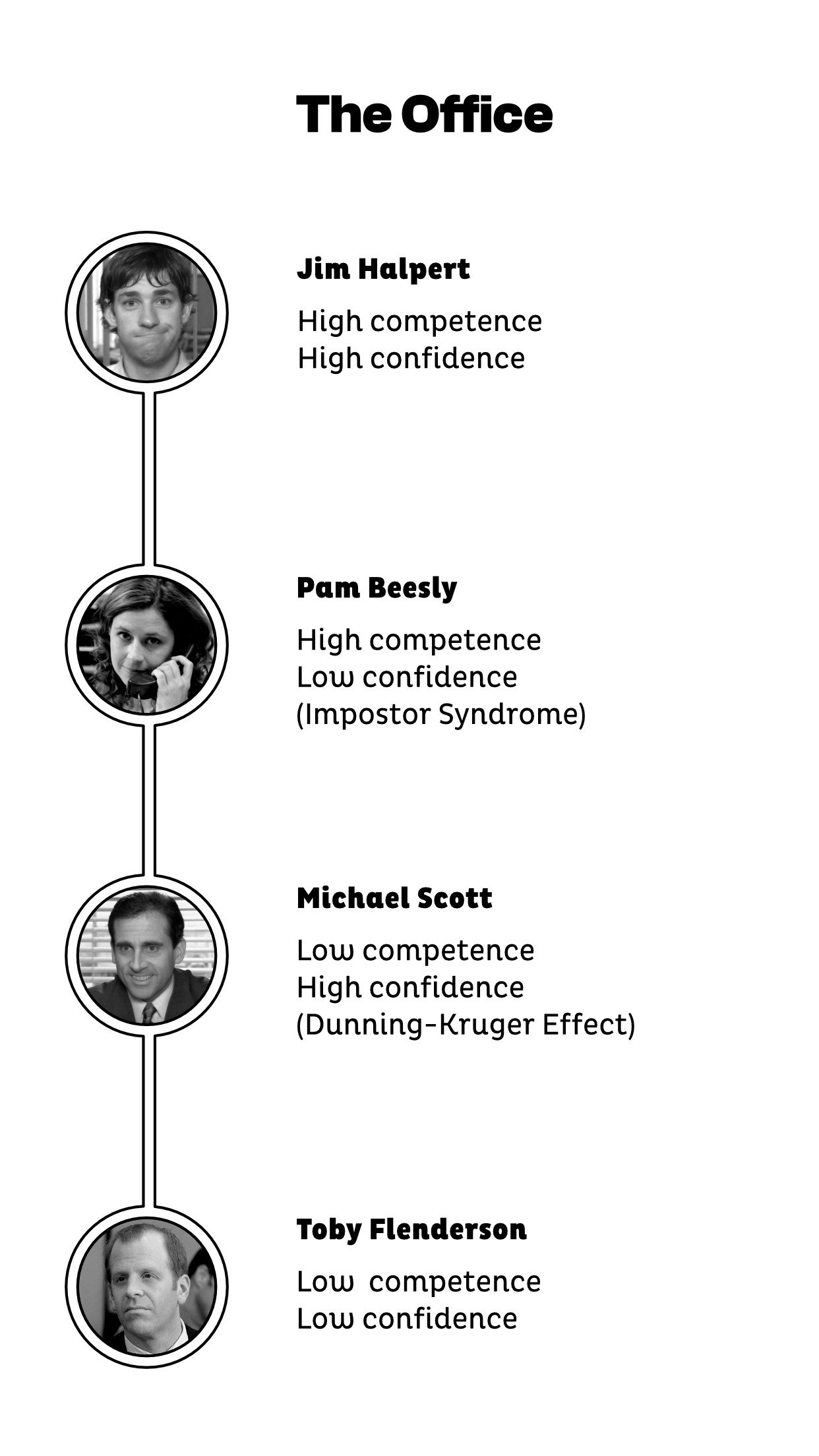
The Dunning-Kruger effect is Michael Scott in The Office.
It's that phenomenon that makes us think we know more than anyone, when, in reality, we haven't a damn clue.
It's what your brother-in-law does at family dinners.
It's what 99% of people do on Twitter.
It's what you do when you start talking about politics.
It's the trap we fall into when we think we're experts simply because we've scratched the surface, watched a video on YouTube, or whatever. It's the threshold of unconsciousness where we don't have enough knowledge to be aware to what extent we are clueless.
The Dunning-Kruger Effect is a guy who thinks he's the best chef because he made an omelet without burning it, but he doesn't know how to distinguish a serrated knife from a filleting knife. Even so, he enters a cooking contest with the confidence of a three-star chef. The result? A glorious disaster and a lesson not learned because, of course, he still believes the judges have no idea.
The problem here isn't that he's incompetent, but that he also ignores his incompetence.
Strange how the less you know, the more you think you know.
Funny though how we've all been there. The Dunning-Kruger effect catches you when you least expect it, and leaves you scarred.
The difference? Some learn and grow; others prefer to keep believing that the world is wrong, and they are the only ones who see the truth.
If you're reading this guide, it's because you've overcome it but have gone way too far and ended up at the other extreme: high competence and low confidence. And you can spend a lifetime in this limbo, blocked up, if you don't get your act together.
And this is where it connects with Imposter Syndrome.
While the Dunning-Kruger walks around with the confidence of a false prophet, the impostor sits in the back row, fearful that someone will discover she's not as smart as she appears.
She who is aware that she doesn't know, and thus feels constantly like a fraud, because she's just too aware of her limitations.
In the end, the secret is to find the balance between confidence and humility. Recognize that you don't know everything, but that what little you do know, you've earned.
Because if you think you're the best at something, you're probably not. And if you doubt your ability, you may be more prepared than you think. Both positions are extreme and unyielding.
So, when you feel on top of the world without having made the effort to climb, take a good look around you. Perhaps you're not at the summit but on the edge of a cliff from which you have no idea how to descend.
Mapping Confidence
Imagine Two Opposite Poles:
- Confidence without Competence: Those who act smart but have no idea. They believe they're the king of the world without any reason for it (Dunning-Kruger effect).
- Competence without Confidence: You, who know a lot, have achieved quite a bit, but still think you're worth nothing. The famous Impostor Syndrome in action.
Confidence, in the end, is merely a point of view. And the most frustrating part is that it doesn't necessarily coincide with reality. If you see yourself as less than you really are, you're losing the game. While if you overvalue yourself, if you think you're more capable than you actually are, you're already winning. Because, as strange as it sounds, that excess of confidence can be very beneficial.
Why? Because when you believe you're better than you are, you enter a positive vicious circle. You get out there, try things, take risks, do new things. And the best part is that this ends up actually improving your skills. On the other hand, with Impostor Syndrome, you get stuck in the opposite. You only see your failures, and if everything seems like a disaster to you, why take risks?
The key difference is this: A confident person, even if not so good at first, acquires the skills they need faster because confidence drives them to act, to try, to improve. While someone who doesn't trust themselves remains paralyzed, trapped in a spiral of self-criticism.
Now, let's look in more detail at the quadrants of competence and confidence:
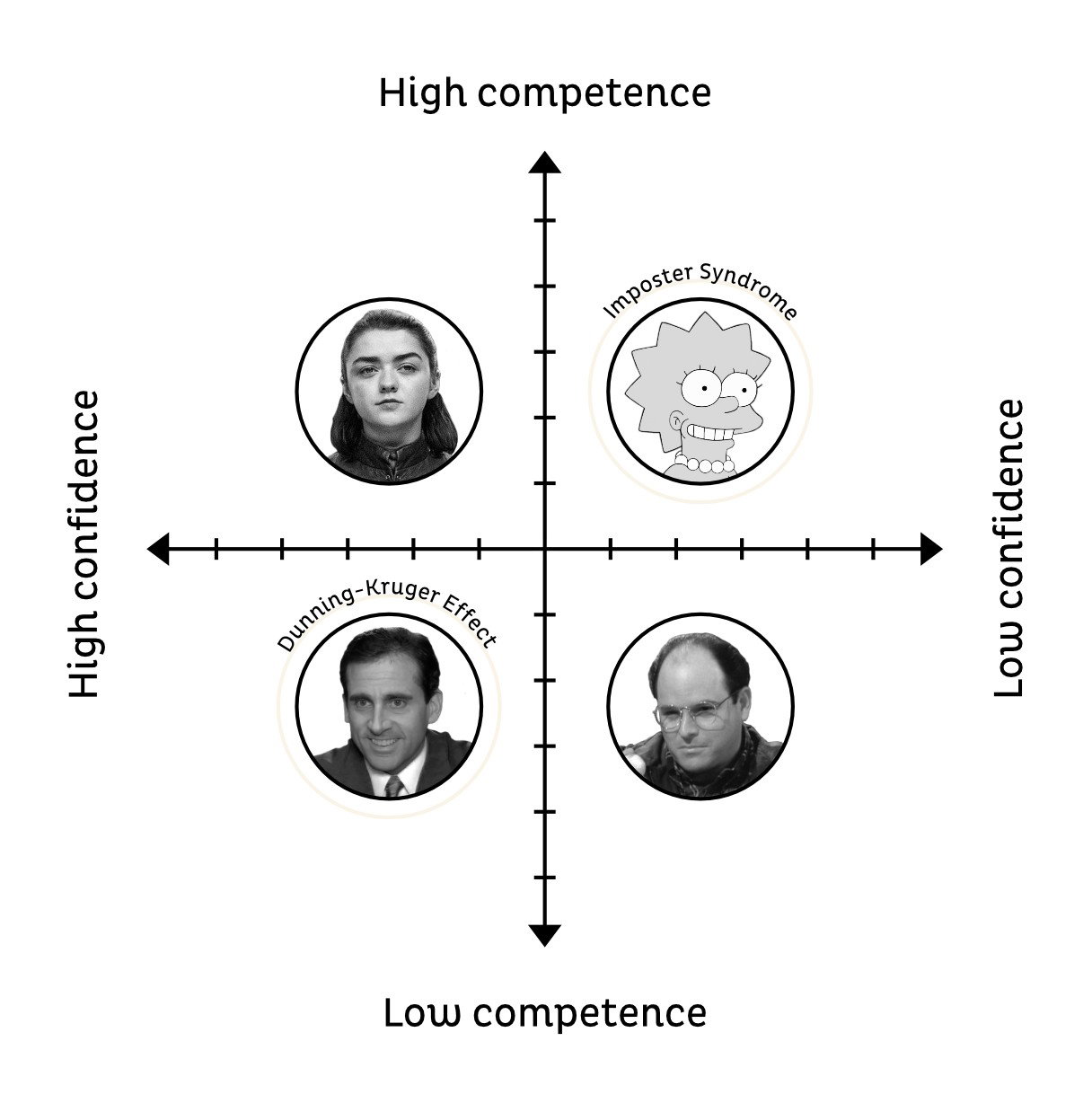
Low Confidence and Low Competence
Example: George Costanza (Seinfeld)
- Those who accept mediocrity as the norm, without effort to improve or advance, trapped in a cycle of low self-esteem and a limited skillset.
- Students or employees who have been poorly guided or undervalued and have internalized a lack of ability and self-confidence.
- Employees who, due to humiliation and toxic work environments, have lost faith in their abilities and hence do not seek to excel.
This is the most tragic quadrant, where a lack of confidence and competence feed one other, leading to total stagnation. People in this group need external support and therapy to escape the cycle of mediocrity and find a path to growth.
High Confidence and Low Competence
Example: Michael Scott (The Office)
- Leaders who rise to positions of power without the necessary skills, but back themselves with excessive confidence.
- Celebrities or influencers who are famous for being famous, without a specific talent to back their success.
- Politicians who, with great charisma and confidence, manage to captivate the masses without real knowledge of public policies.
This quadrant represents people who benefit from the illusion of competence, achieving elevated positions or notoriety without real skill. Society often gives them a pass due to their ability to project confidence, although this can have dire consequences.
Low Confidence and High Competence
Example: Lisa Simpson (The Simpsons)
- Artists who, despite their talent and skill, suffer from Impostor Syndrome and constantly doubt their worth.
- Researchers and academics who are experts in their fields but feel insignificant or that their achievements lack brilliance.
- Engineers, technicians, and developers who, despite their technical competence, question their place in the industry.
This quadrant reflects the classic Impostor Syndrome. Brilliant and talented individuals who, due to an excessively critical self-evaluation or a lack of external recognition, doubt their abilities and capacities. This group needs external authority figures to constantly reaffirm their value to avoid self-sabotage.
High Confidence and High Competence
Example: Arya Stark (Game of Thrones)
- Athletes who combine technical skill with a strong and confident mindset, allowing them to stand out in their fields.
- Entrepreneurs who not only have a clear vision and strategy, but also the necessary confidence to execute these successfully.
- Charismatic leaders who are not only competent but inspire others to reach their maximum potential, leading to significant transformation.
This is the ideal quadrant: high confidence, high competence. This is where we find those who achieve great things, those who inspire others. They are capable of transforming much of what they touch.
They aren't superheroes; they are normal people who have found the perfect balance between knowing what they're doing and believing in themselves.
Interestingly, they aren't much more skilled than those who suffer from Impostor Syndrome. The difference lies in how they manage uncertainty. It's not that they aren't afraid; they just don't let it paralyze them. They know they can't control everything, but they dive in anyway, assuming the consequences, for better or for worse.
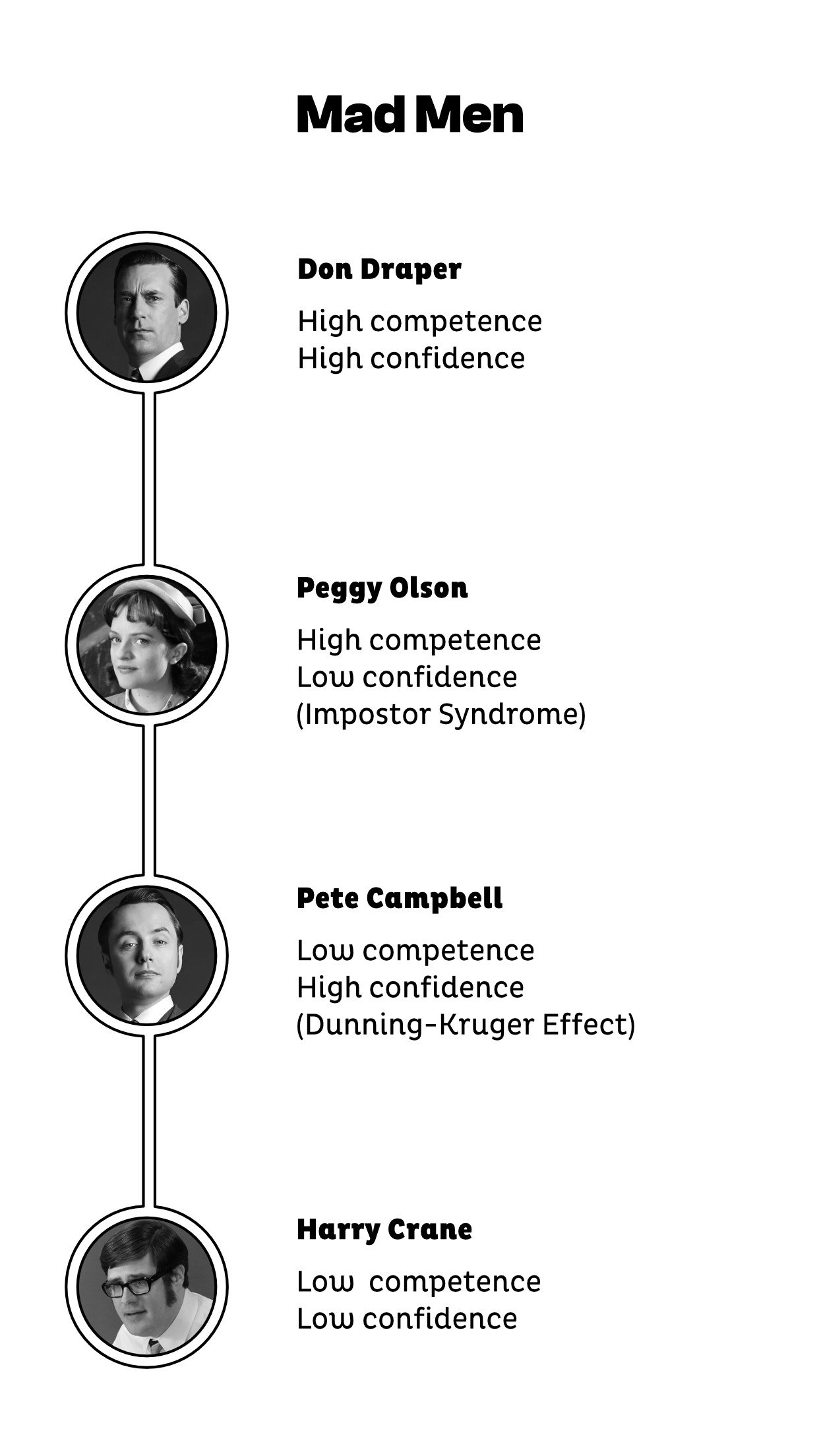
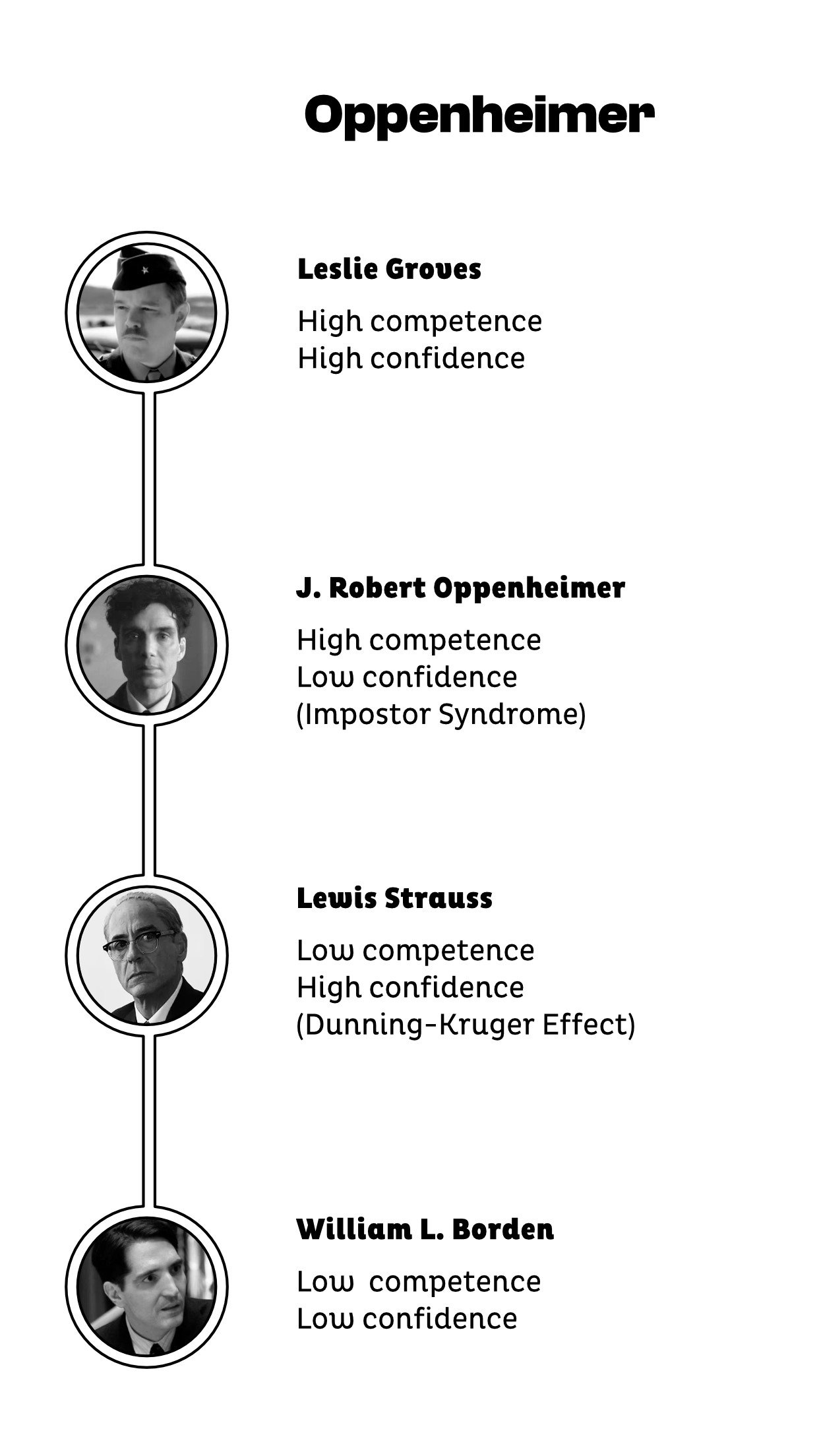
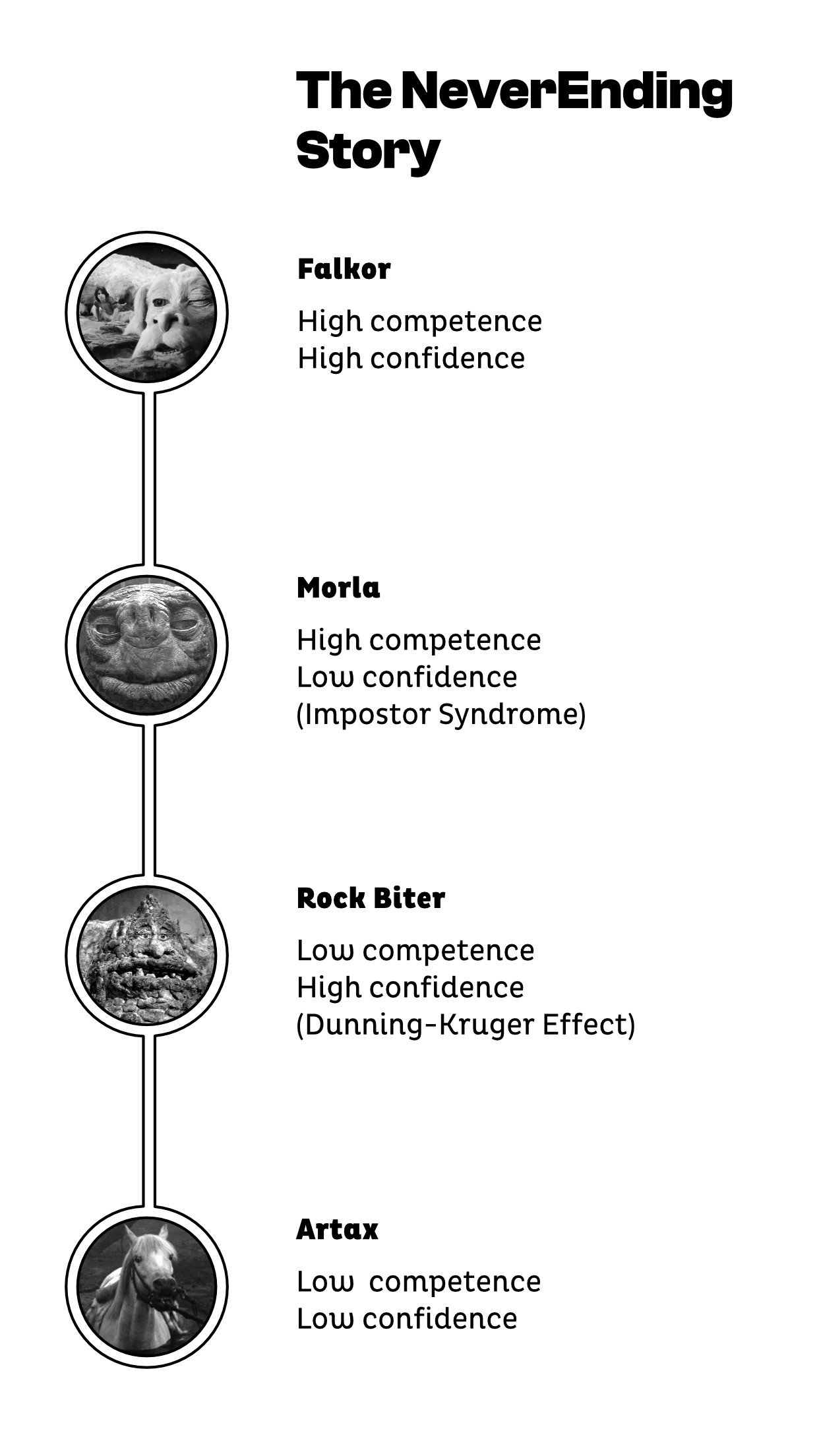
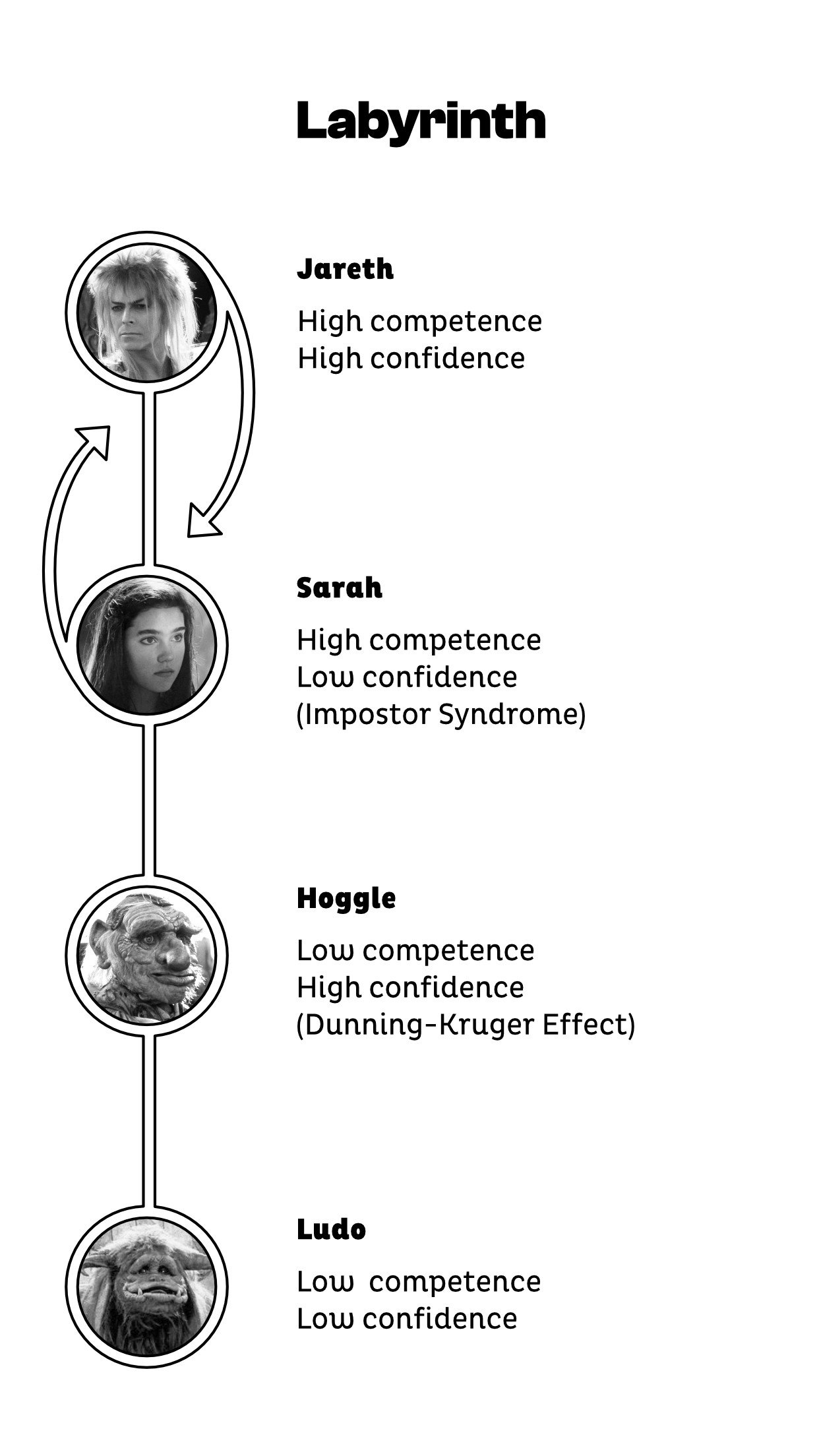
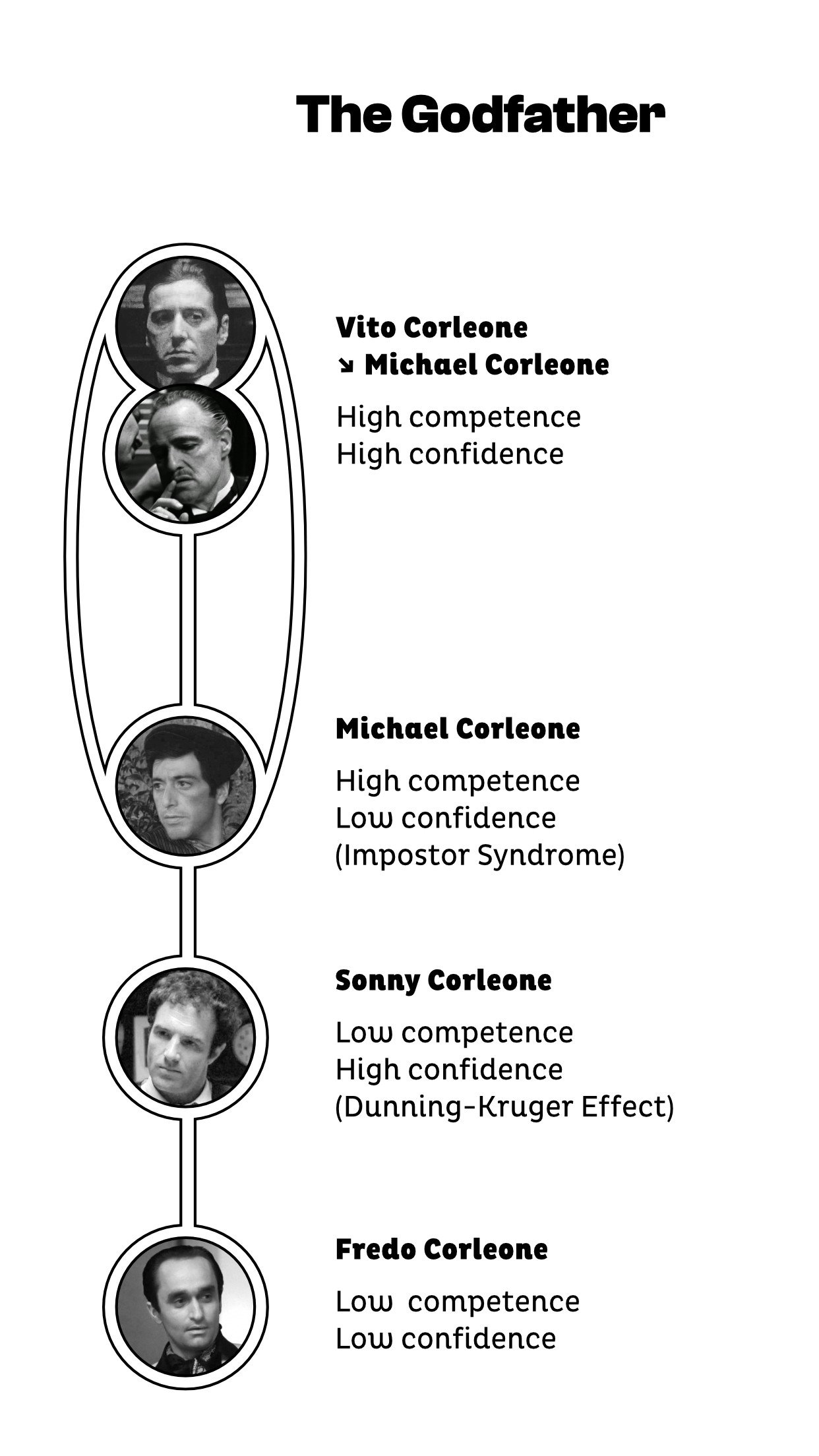
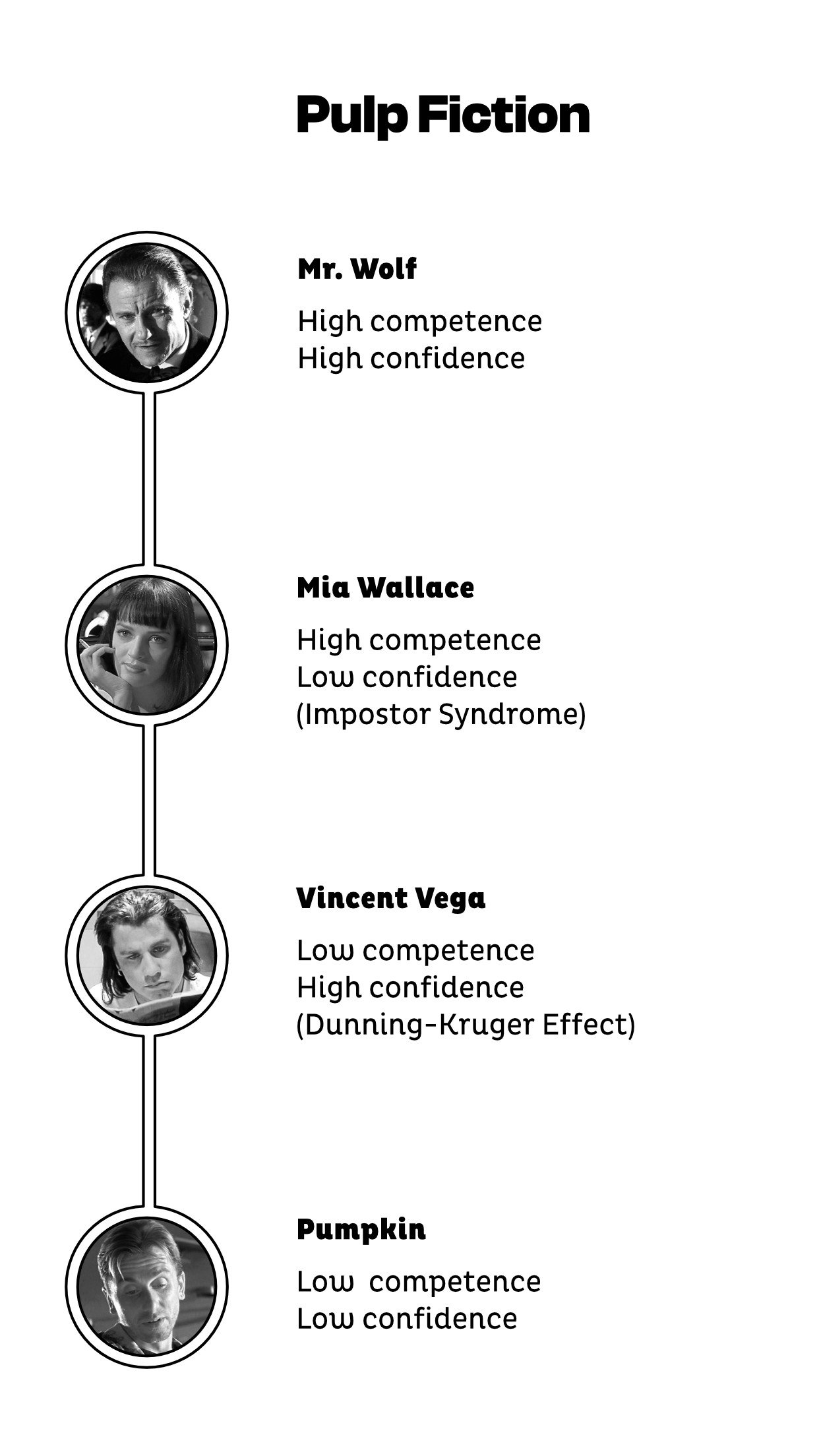
Impostor Syndrome in Great Stories
Where does Impostor Syndrome fit in great stories?
The characters that captivate us most in great stories often fall into a very specific quadrant: high skill but low confidence. They aren't perfect; they don't have all the answers.
Heroes don't see themselves as heroes.
They make mistakes and doubt themselves, and this humanizes them, brings them closer to the audience. It's easy to identify with them because we also live in uncertainty, trying to be good at what we do without being sure if we're succeeding.
On the other hand, there are those who do have both skill and confidence. They are the mentors, the wise. There to lend a hand, guide the lost hero, give them the push they need to believe in themselves. They've already gone through the ordeal of doubt and now dispense wisdom as if poker chips.
And then there are the villains, those who think they know everything but have no idea. They are the ones living the Dunning-Kruger effect, who go through life as if they were the kings of the world and, surprise, end up face down.
Unless, of course, they decide to redeem themselves and start seeing the world as it is, which does often happen.
Many great artists start out as pretentious jerks without any competence, but manage to swallow their pride and learn with humility.
The interesting thing about all this is that almost no one stays in one quadrant permanently. We are fluid. You can be great at one thing and a disaster at another... Time and effort are key to seeing a transformation.
And that's where we connect. We are neither perfect heroes nor absolute villains. We are chaos, contradiction, a bit of everything. We try to understand the world and progress. Just like them.
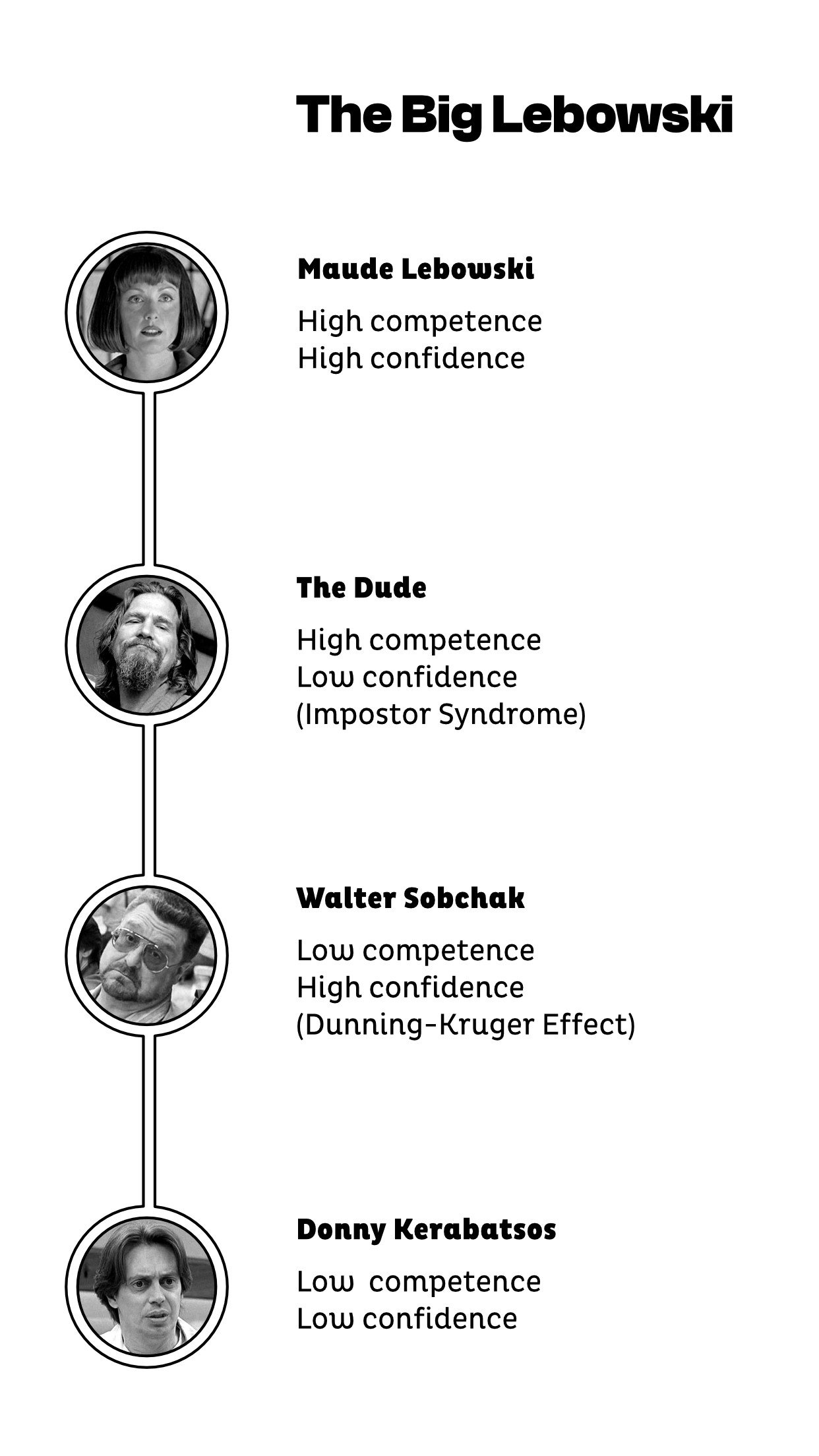
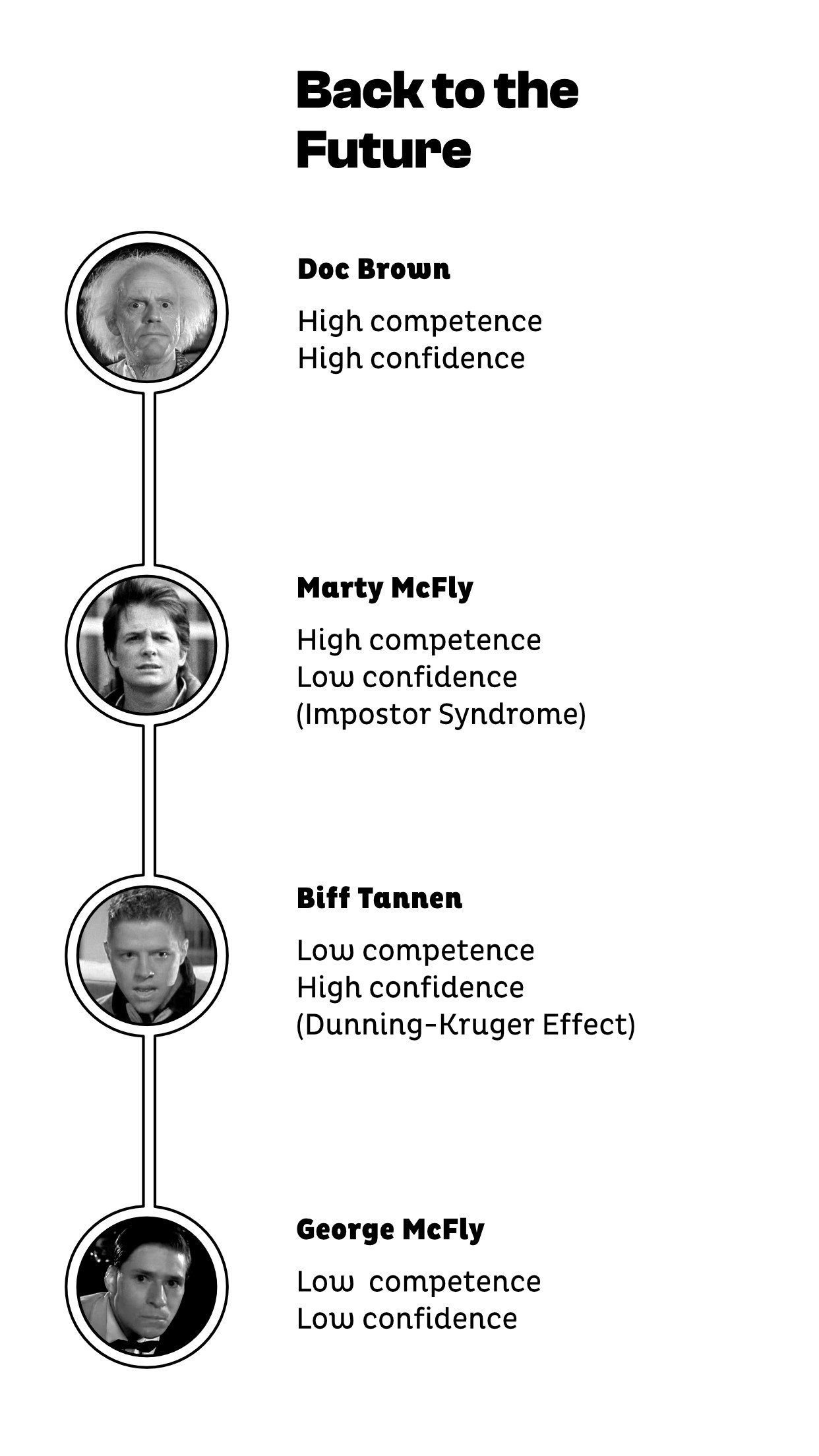
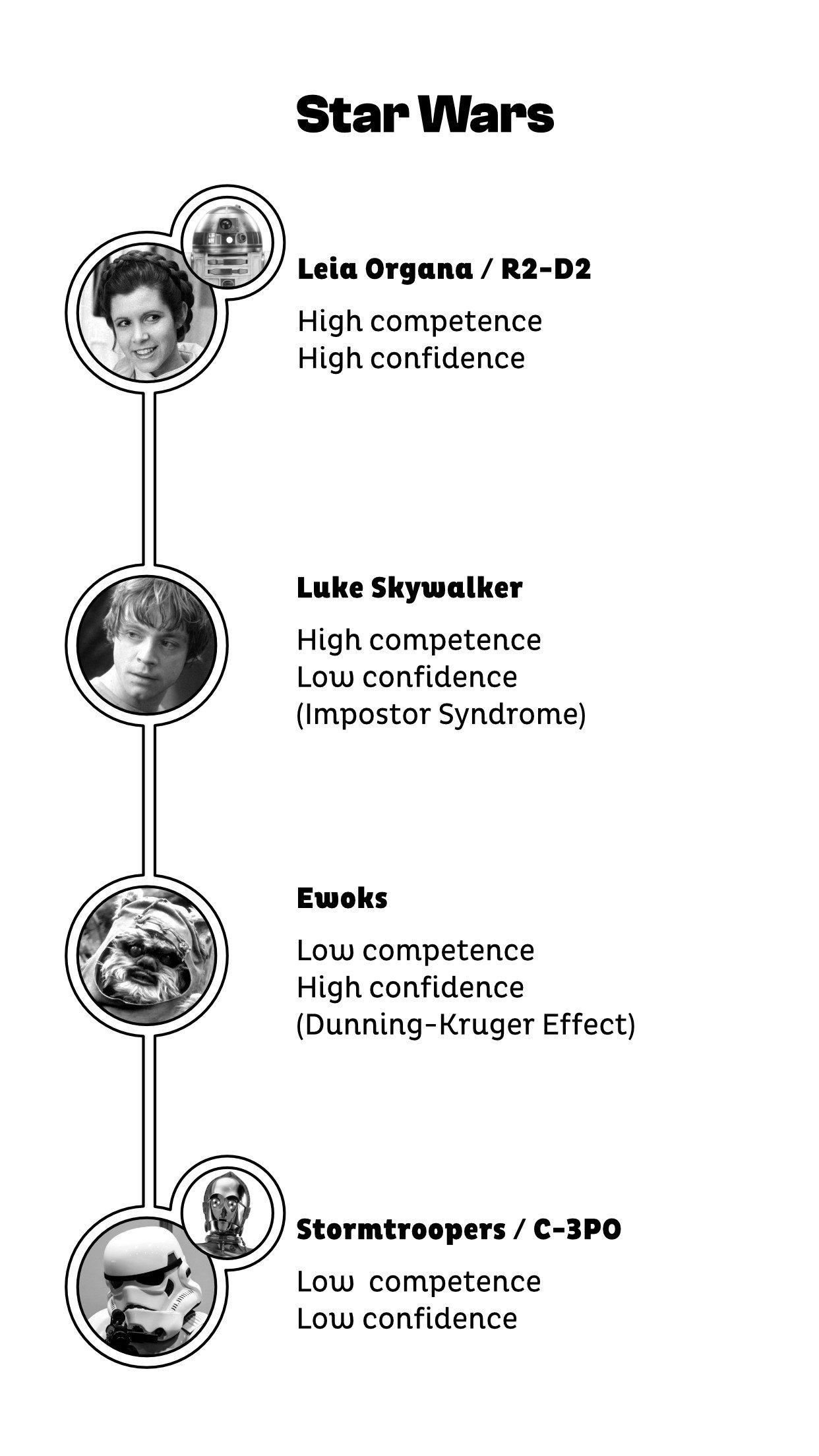
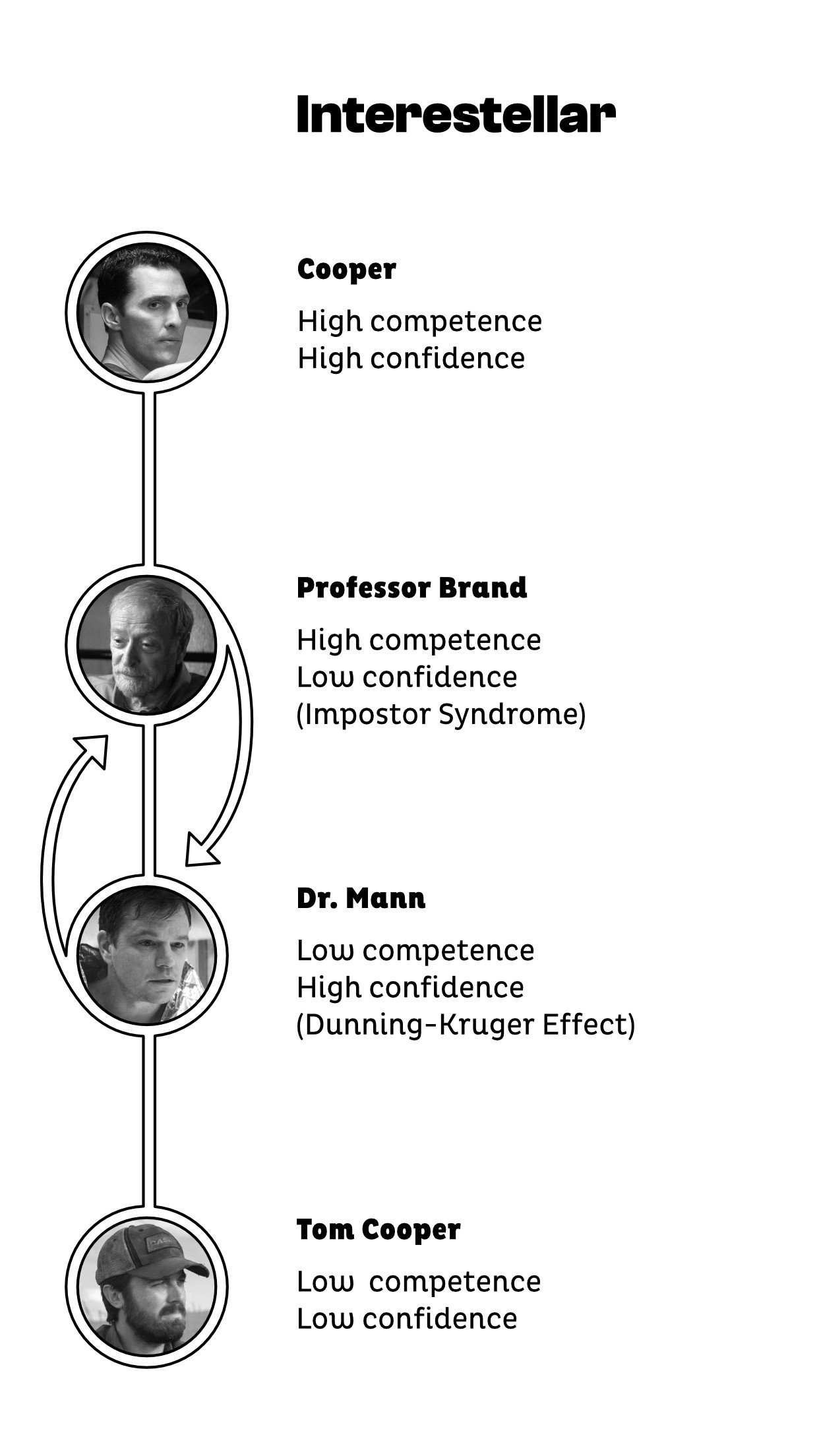
Look at Dr. Mann in Interstellar, a brilliant astronaut who has everything needed to be a hero but chooses to be a coward. Or Dr. Brand, midway between representing hope and disappointment. She's quite capable but also a liar, oscillating between what she could be and what she really is.
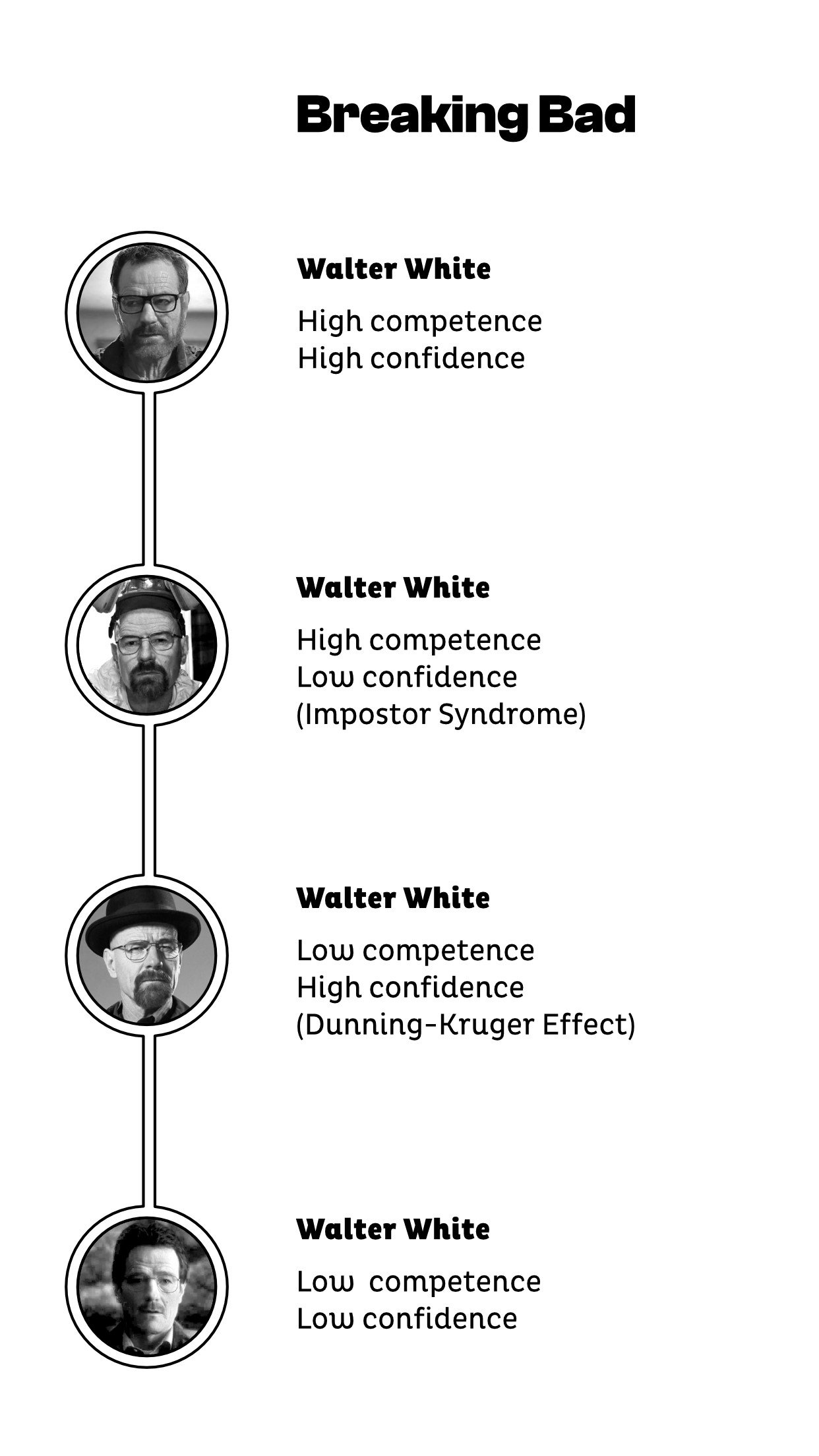
Or Walter White in Breaking Bad, who goes through all the intermediate states from low competence and low self-esteem to high competence and high self-esteem.
There are great lessons in stories, and I think you'll see this much more clearly below...
Don't Be Such a Crybaby
If your excuses, your crazy expectations, and your alarmism anticipate action, brace yourself. You won't even begin.
Every day you do small things, make small advances. But since they're not grandiose, you dismiss them. Because, of course, you feel like an impostor since you aspire to maximum greatness, and it's all or nothing for you.
Great achievements come from those tiny steps that lead you to trust in what you do. But you want everything at once. If you don't win the lottery, you don't play.
You don't accept the grays. Climbing steps isn't your thing. You're a bit inflexible about taking one step at a time.
That's how arrogant you are.
How is it possible that someone so insecure is so arrogant?
Humility and arrogance are two sides of the same coin: If we consider that extreme humility can turn into submission, and arrogance can be a shield against vulnerability, both behaviors are fueled, in some cases, by the same fear of failure or inadequacy.
The correlation between humility and arrogance reflects different responses to the same underlying insecurity. Instead of seeing them as mutually exclusive, we could consider them as adaptive strategies in the game of ego and self-esteem.
Aha, insecurity can lead you to exhibit extremely humble behavior, while also simultaneously to extremely arrogant behavior.
Believing and doing are the same, two sides of the same coin. If you separate them, you're screwed.
One who has confidence but ignorant always blames the world for their failures. It's not that they don't know; it's that the universe conspires against them. While you, who know what you're talking about, show doubt.
Why?
Because Impostor Syndrome is a chameleon: it adapts, finds new excuses, invents new ways to tell you that you're worthless.
Remember that you're hooked on the drama of feeling like a fraud to free yourself from the responsibility of being brave.
Unlike the confident incompetent, who blames the world for their failures, you, with competence but lacking confidence, blame yourself.
Thus, we have a clear pattern regarding blame:
- Those with confidence but lacking competence (Dunning-Kruger) blame the world. They externalize blame and assume no responsibility.
- Those with competence but lacking confidence (Impostor Syndrome) blame themselves. They internalize blame and similarly don't take responsibility.
Both look for someone to blame, victimize themselves, don't take responsibility, and believe they can't change anything. They assume a passive role, as if everything that happens to them is beyond their control. Neither the Dunning-Kruger nor the Impostor Syndrome take responsibility for their lives.
The Path to Competence with Confidence
To possess competence and confidence, stop looking for someone to blame, don't victimize yourself, and take responsibility for changing your circumstances.
High competence with high confidence arises when you assume that what happens to you is a projection of your decisions.
Sure, life tests you, but in general, you get what you deserve. There are exceptions, but it's unlikely that you're one of them.
Creativity at the Service of Excuses
Impostor Syndrome is a thing of highly creative people, judging by the excuses you come up with. You're the Velázquez of excuses, the Bach of conspiracies, the Stephen King of justifications.
The trick is to find balance. There's no world where you have only confidence or competence; we're always floating somewhere in between. But the further you move away from the center and move toward extremes, the worse it gets.
Impostor Syndrome paralyzes you before you can do anything. And the solution is simple: act first, think later.
Action generates confidence.
I'll repeat it so you don't miss it:
- Act first and think later.
- Taking action is thinking.
- Action generates confidence.
Keep these ideas in mind. Later we'll delve deeper…
Break the Cycle
If your excuses, your crazy expectations, and your alarmism anticipate action, brace yourself. You won't even begin.
Do these three things, and you'll see how your mental state changes:
- Act first and think later.
- Aim to do a bad job; you'll improve later.
- Do it as if no one was watching you.
If you manage to do these three things, everything will go much better than you imagine. As you gain confidence, when doubt, uncertainty, or reasonable excuses assault you, you'll pay no attention.
Then, you'll see Impostor Syndrome as if watching a cloud pass by. Something natural, expected, part of a larger process that doesn't stop.
You're in control.
Don't let yourself be intimidated by your own judges. You gave them life, and you'll shut them up. Only you have that power.
And about doing it as if no one was watching —more on that toward the end…
Believe in Yourself So Others Believe in You
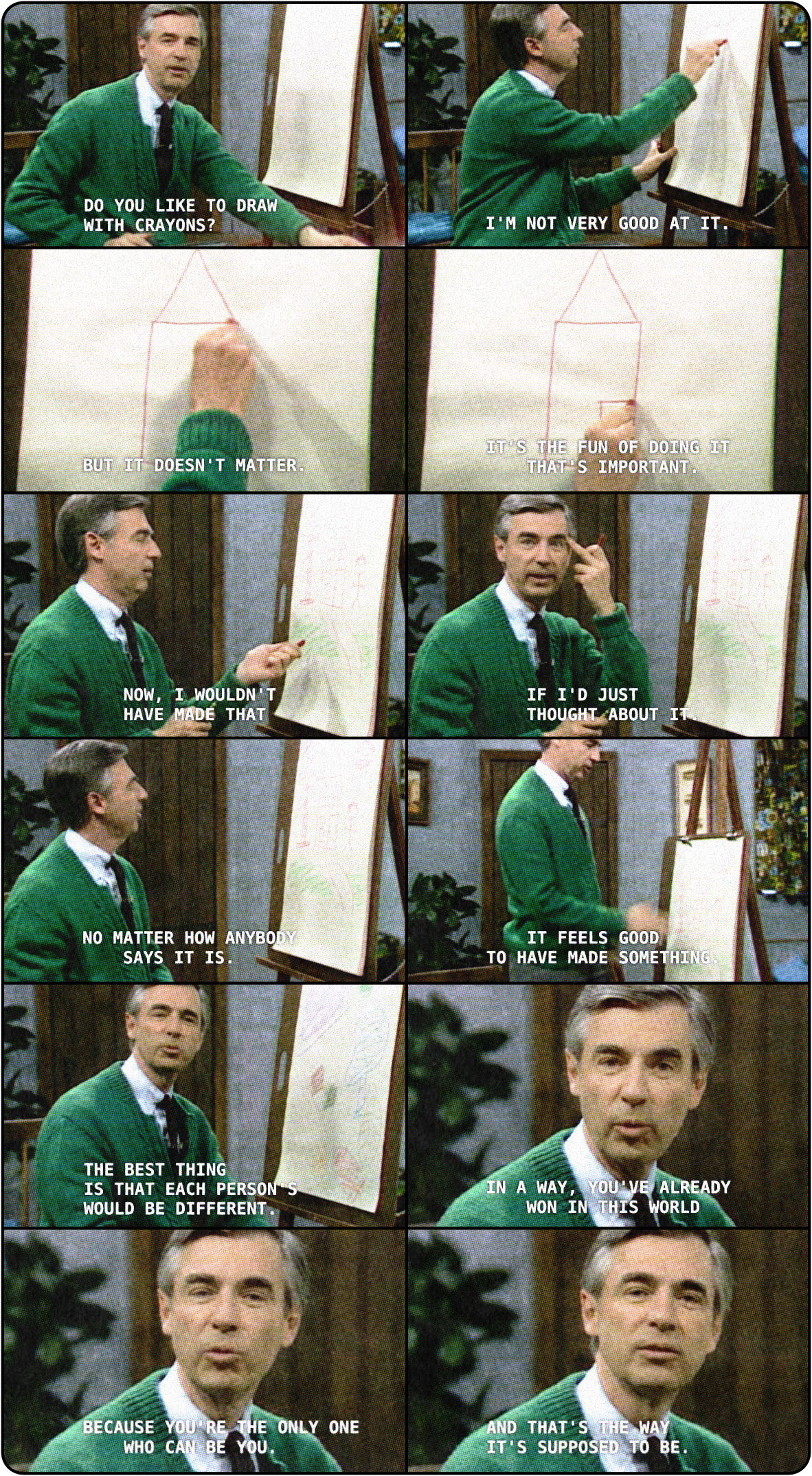
First believe, and people will follow you.
Your Cover Sucks
What if Impostor Syndrome was a book?
A book is not so different from an artist. It has a form, content, and an audience.
A book needs both a good cover to capture interest and good content that impacts directly on the heart so the effect endures over time. If one of these two aspects fails, relevance and memorability are drastically reduced.
The real strength lies in balancing appearance and content to create a complete work. A good book, besides good content, must have a good cover.
Let's see how to apply the Confidence vs. Competence quadrant to books:
- Low Confidence and Low Competence: It's a book with a boring cover and mediocre content. It neither attracts us visually nor adds value, making it entirely dispensable and forgettable.
- High Confidence and Low Competence: It's a book with a stunning cover but lamentable and poorly written content. It hooks you but disappoints once you start reading. No one would recommend it.
- Low Confidence and High Competence: It's a book with excellent content but a terrible cover. Although the content is valuable, many overlook it because the presentation doesn't do justice to the message. The first impression is disappointing, but those who get past this initial barrier and read on will recommend it.
- High Confidence and High Competence: It's a book with an attractive cover and deep, well-written content. Both the presentation and the message are spectacular, and the book leaves a profound and lasting emotional impact. It's a book that, besides having great appeal on its own, everyone recommends.
In summary, your book is great, but your cover is a nightmare.
Your cover is a coitus interruptus. It breaks the magic. It disqualifies the content.
A bad cover anticipates that, almost certainly, the book won't be worth it. Because of course, what can you expect from an author who accepts presenting their work with such a terrible cover?
The cover is how we convey expectation, and this expectation greatly affects the mental state in which we read the book. It's not the same to read a good book well-edited as one poorly edited.
We judge the content not by what it is, but by what it is within a certain context. A good book with a bad cover is a misfortune, and its reading is tainted by its mediocre presentation.
The cover raises suspicion in the reader: someone willing to condone such a mediocre cover just can't be a good writer.
It's ironic. Because the hardest part —writing a good book— you've already done.
If you didn't know how to write, you wouldn't suffer from Impostor Syndrome. Remember the second revelation: Impostor Syndrome is inseparable from knowledge. You can only feel like a fraud when you know what you're doing and have a map of the terrain in your head.
But your presentation doesn't respect your work. It's as if the cover nullifies the book's content. After all the effort of writing it... what could justify such an incredibly bad cover? What could lead an author to accept a presentation that disrespects the work?
Only a dark thought that the book isn't worth it, that it shouldn't be found, can justify your book having a lousy cover.
Your cover is so bad that anyone would assume you're trying to disrespect, hide, or censor something...
Perhaps because, deep down, you're afraid they'll read it?
Give that some good thought.
If your skills are a 10 but your confidence is a 3, will people see you as a 10 or a 3?
First Believe It
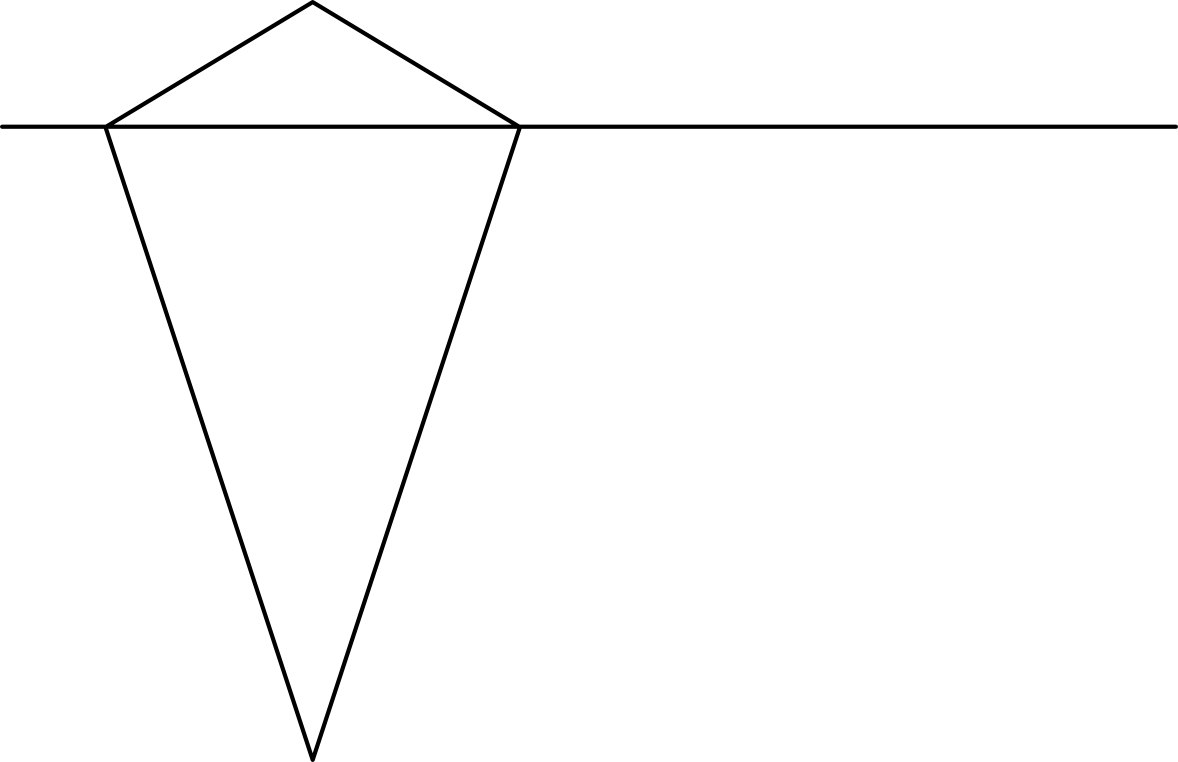
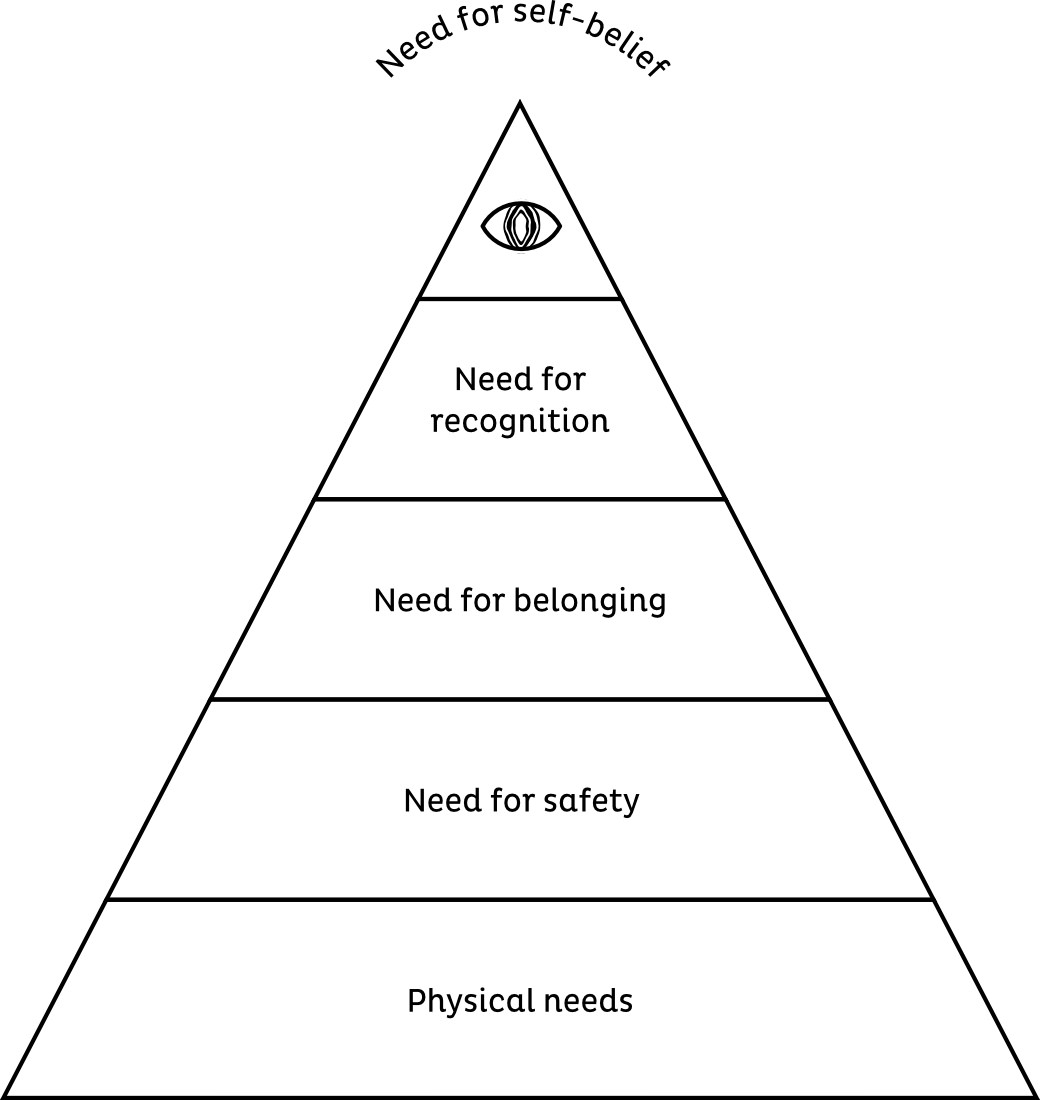
If you want to succeed as an artist, having confidence is crucial. Actually, it's the most important factor.
Yes, having confidence is much more important than having skill and competence. Now you'll see why.
Here's the drama: We spend all our time and energy learning technique, and nearly none (or none at all) on building confidence.
It's a tremendous disproportion.
Because the belief that our ability is sufficient isn't something you just spontaneously catch, like a cold. Confidence is worked on, taught, practiced, trained.
Beliefs are emotional technology, and you've overlooked this subject for whatever reason. You're tremendously unbalanced and drowning in a glass of water.
It's not 100% your fault. Because tell me, what school teaches belief and confidence?
Honestly, I think the only place that exists with this mentality is Quarantine.
Earlier, I told you that having confidence is more important than skill. Let me explain:
Artists with confidence learn to do things better over time. First, they do it badly, and that's okay. They accept this and assume it will eventually turn out well.
"Would you believe in what you believe in if you were the only one who believed it?"
Kanye West (Doesn't matter if you don't like him. He couldn't care less.)
This bravery leads them to experiment with fewer and fewer complexes, to advance based on trial and error. And experimentation is the best school for an artist.
And sooner or later, they come up with something, and their art, even if it's not incredibly good yet, already has a clear vision and identity. Something of their own. Something that goes beyond trying to do well. Their technical vulnerability isn't a problem as long as their vision is unique and convincing, because that's almost the only thing that matters to the public.
Because the audience likes well-crafted work, sure, but don't realize how important it is to them. Or at least they don't care as much as you do, that's for certain. Keep in mind that they are not artists like you; they aren't necessarily geeks. And you'd be surprised at how little or no importance they give to the things that keep you up at night.
Just as an architect doesn't design houses to impress other architects, but for people to live in... you shouldn't create your art with the ambition of passing the evaluation of other artists, but instead to connect emotionally with your audience.
Come on, the technical aspect isn't that big of a deal, and almost all the artists I know say that the technical part is the easiest. What's really tough is precisely everything else. All that is never even mentioned in schools. The part about connecting with people.
So a mediocre artist with confidence has a lot of potential.
And a skilled artist without confidence... well, maybe they only have potential as a teacher. Sorry, but that's the truth.
An artist without confidence, over time, will only bury their talent deeper and deeper until one day there's no trace of it.
Because for this type of artist, there's no trial and error. There's only error, and the resulting remorse and frustration. They don't tolerate error, they despise it. They think it's something for the weak and mediocre. And when it happens to them, they fiercely hide it. Heaven forbid someone judges them as weak and mediocre.
Heaven forbid they run into someone as inflexible as they are, and get called out.
Little by little, they become a self-conscious whiner, cowardly and unable to manage a creative process that involves even minimal risk. They'll play it safe, doing what they already do well, what everyone praises them for. And they'll badmouth the brave ones who try to do things differently without feeling any shame.
So the mediocre with confidence allow themselves to make mistakes and live with them without drama, but the Impostor Syndrome has less street smarts than a Roomba.
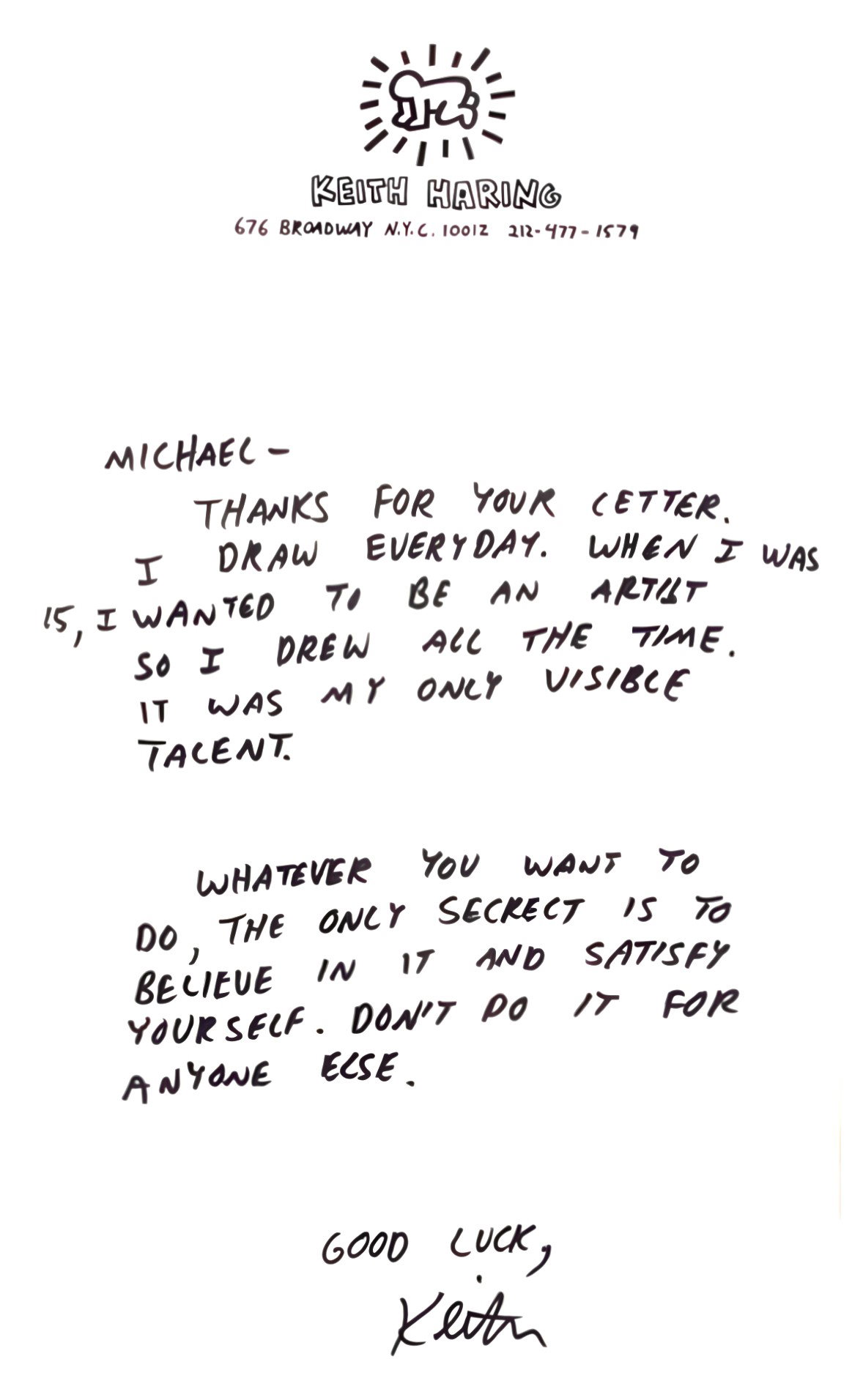
And at the slightest opportunity, they will badmouth artists technically inferior to them, but who make a better living than they do, and they'll enter a spiral of frustration and anger that will further fuel their insecurity. They'll cry out to their lord and the heavens that the world belongs to the mediocre, and at no point will they consider that maybe they just might be wrong.
Such is the arrogance and ego of those with Impostor Syndrome. They can't stop comparing, measuring, criticizing, censoring, judging, auditing.
The insecure artist is hostile.
They believe the world is unfair and owes them something. The truth is that their work doesn't engage, but their ego is too inflated to accept the terrible fact that no one is going to applaud their insecurity.
So the best investment you can make for your art is to believe in what you do and gain confidence. Do it for yourself and for your audience, and send all those imaginary judges packing.
Look, if you dedicated half the time and energy you spend learning technique to training your confidence, trying things, testing yourself, without fear and without expectations, I give you my word that your artistic life would improve. A lot. Unimaginably better.
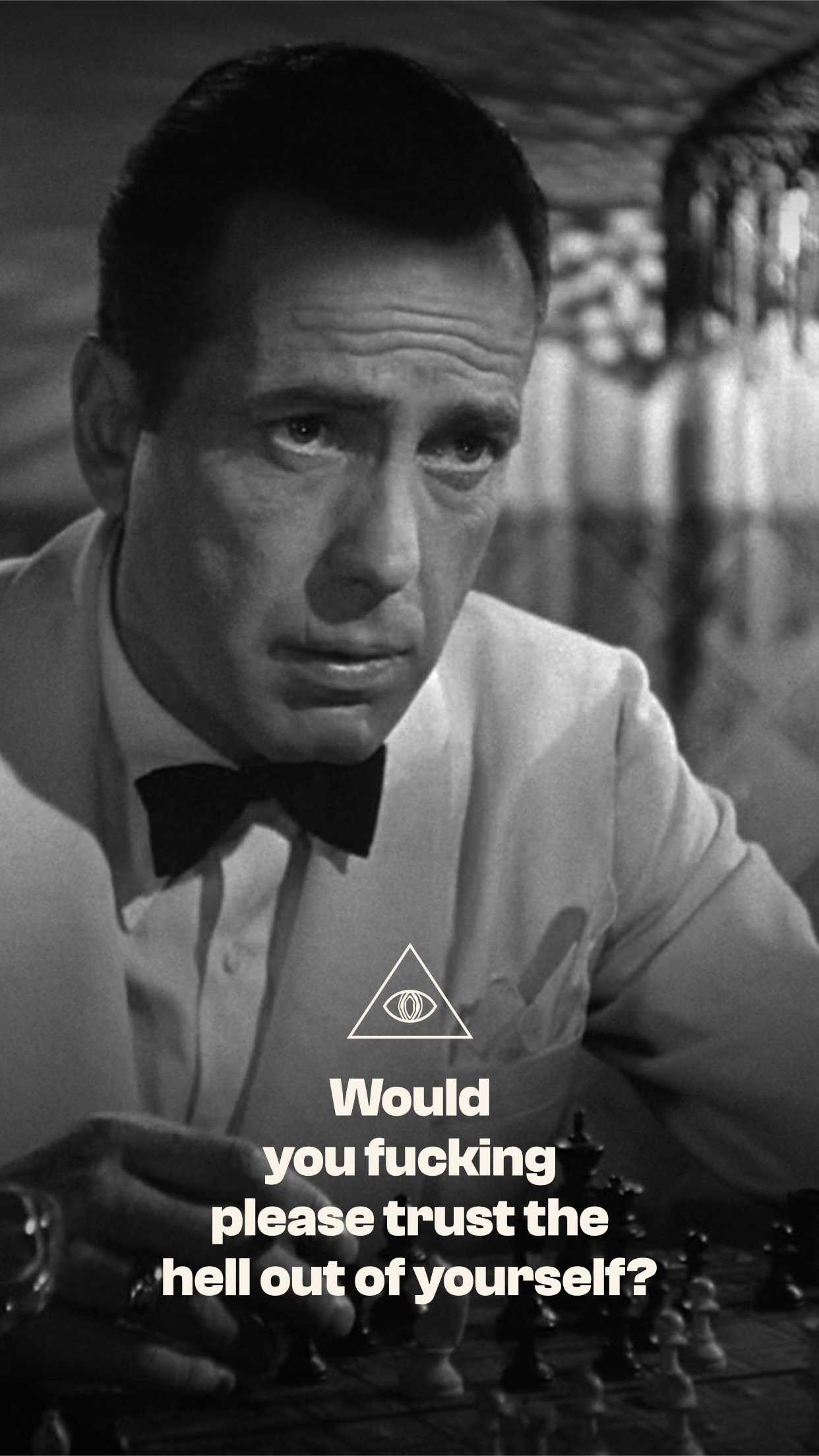
Accustom yourself immediately with the idea that it's just fine to try things and have them turn out badly. They'll turn out well eventually.
You're not mediocre for making mistakes. On the contrary: you stop being mediocre by accepting and correcting mistakes.
- Experimenting and failing in the process is thinking. That's how you progress.
- Feeling remorse and torturing yourself because something isn't turning out well isn't thinking.
- Hiding your vulnerability instead of using it isn't thinking.
The truth is that we don't actually progress that much when something turns out well either. No matter how much you achieve, Impostor Syndrome will find new ways to mess up your life and point a finger at you. It's not that you're a fraud; it's that your mind is programmed to underestimate yourself, and you pay it too much attention.
Don't pay that much attention when that little voice emerges.
Don't be a hypochondriac of thought.
Don't pay too much attention to your inner demons.
Don't take yourself so seriously; everything shall pass, and nothing is that important when seen from a distance.
As I said before, many can teach you technique, but how to gain confidence... that's much harder.
Schools ignore this, and much of their faculty teach precisely because of their lack of artistic confidence. There are very few teachers with true vocation, and the vast majority are professional escapists.
Teachers don't teach how to believe in yourself. They don't see it as something important or even teachable. They believe it's merely up to you, and that you'll manage.
And you don't manage, of course.
And confidence is precisely what makes the difference.
Irresponsible bastards.
It doesn't matter how good you are technically if you don't have the confidence that what you're doing is worthwhile. Because if you don't trust yourself, no one will trust you.
People don't perceive directly the real value of your art, but the value you're able to convey. And low self-esteem prevents the message from reaching the audience with clarity and impact.
Well, actually, a very clear message does come straight through: one of self-consciousness, of someone trying to do well, but who definitely doesn't express themselves with strength and clarity, because they're afraid.
It's an awkward, discouraging message that anticipates very low expectations.
It's a frustrated message.
In other words, the lack of confidence exerts an inverse persuasive effect. A rejection effect.
Because no one admires someone who's afraid. No one buys cowardice.
People value art that is unashamed, visionary, bold, uninhibited, and direct.
What's the point of learning to make art if you're afraid to convey your vision?
Do you see the radical importance in all this? It's tremendous.
More important than being good is appearing good. The Greeks knew this very well: "If it looks good, it is good." Do you make it look good? How do you present yourself to the world?
This may seem like black magic, and maybe it is. But this is the terrible truth you must accept as soon as possible: if you don't first trust yourself, no one will trust you.
The lack of confidence is coded into every gesture, every decision, every detail, every word. I don't know exactly how it happens, but it happens. Insecurity is encrypted and represented in your work. It's inevitable. Your insecurity becomes part of your work automatically and involuntarily.
The lack of confidence corrupts the artwork and it reeks of the need for approval.
And no one buys insecurity.
No one will trust something that the person in charge doesn't trust.
And you don't either.
Would you live in a house where the architect isn't clear about his plans? Would you let an insecure hairdresser cut your hair? Would you take classes from someone who isn't clear about what they're teaching you? Would you let a surgeon who isn't sure about the operation cut into you? Would you marry someone who doubts they can be faithful to you? Would you trust an airplane pilot who has doubts about her competence?
Anyway, you get the idea.
As I was saying: no one buys insecurity.
And you don't either, admit it.
No one admires the work of a coward. If you don't trust yourself, you discourage. If you don't trust yourself, no one will do it for you.
If you don't believe in your art, even if it's imperfect, no one will believe it's good.
It's your responsibility to believe in what you do and accept that it won't be perfect.
You don't have to wait until you feel secure to act. Go on. Confidence will arrive.
Confidence doesn't come from being ready, but from acting despite not being ready. Every step you take, however small it seems, reinforces your confidence.
This is the golden rule you must understand, internalize, engrave in fire:
You must believe first, and that belief will spread like a virus through your art, by emotional contagion.
You still don't believe me, but one day you will agree with me on this.
Hopefully soon.
In theory, there is no difference between theory and practice. In practice, there is.
Yogi Berra
You Know Too Much
In our education, many of us feel that something is missing beyond theory and method.
We search for answers outside our field, but we always end up at the same point: learning is not the same as knowing.
Knowing comes from doing, from experiencing. Learning comes from studying, from thinking. It's obvious; living life is not the same as talking about it. Understanding art is not the same as creating it. And we certainly don't learn to love by reading books about love.
You know this, right? Maybe you want to read about love after having loved, but... please, NOT BEFORE! What's wrong with us?
Are we crazy?
We are crazy.
We go through life believing that the more we know, the more prepared we are. And in part, it's true, but it's also a trap.
Don't get me wrong: studying is very good, but not when done before trying things for yourself. Studying should come after acting, while you experiment, while you learn by trial.
Education should not become the perfect excuse to indefinitely postpone action. It's the most perverse excuse, because studying always seems like a positive. No one will suspect that education is a pretext to avoid taking action. Studying sounds good; it's the ideal hiding place.
But the reality is that many hide in their studies because they fear facing the real world, outside the comfort of the academic bubble.
Moreover, added to the fear of new experiences, today there is just so much information, so many schools, methods, and books, that we end up confused and overwhelmed. We try to apply what we've learned, but we do it defectively, insufficiently... And then comes frustration, guilt, and the famous Impostor Syndrome.
Confusing the map with the terrain is a typical mistake. It's like confusing time with clocks. It's like thinking that reading about art is the same as making art. It's like traveling with Google Maps.
Understanding the ideas behind a creation is relatively easy, but living them, making them your own, is another story. It's when ideas stop being just words and become experience. When you truly live them. When they take root and you become those ideas without having to contemplate them.
There is a great abyss between studying art and making art. They are utterly different things.
You've become so obsessed with learning that you forgot to take action. The more you know, the less you do. And the more you know, the more afraid you are of messing up.
It's inevitable. It's Impostor Syndrome.
And do you know what your problem is?
"You know too much."
What's Wrong with the Academic Method
The academic method follows three basic steps: 1. Study. 2. Practice. 3. Evaluation.
First, you study. Then, you try to put what you've learned into practice with exercises of increasing difficulty, and your results are evaluated and graded. All this assuming that you're motivated and that, over time, you'll know what to do with everything you've learned.
It seems logical. But if we're talking about art, things don't work that way.
This approach may make sense in fields like chemistry or mathematics, but it doesn't fit well with the visual arts.
Since we were little, they've ingrained this idea in our heads, and it's hard to overcome the conditioning. It's like a mental prison, but like all prisons, there is a key. It's possible to change this belief, I assure you.
The conflict lies in that the academic method is based on three ideas that, in art, are completely false:
- False Belief #1: Perception is passive.
- False Belief #2: Action is passive.
- False Belief #3: Errors exist and should be avoided.
...but the truth is quite different:
- Perception is not passive. Perceiving is thinking. Observing in different ways equals thinking in different ways.
- Action is not passive. Doing is the best way to learn. Doing something is inseparable from how we perceive it. Experimenting and trying is thinking in action.
- Error is a point of view. In art, error is a necessary element of contrast to express correctness. Failing is thinking. Making use of errors is thinking. Making mistakes is a way of thinking and learning.
Visual Empiricism
We know that no method is perfect and that all progress has its price. Learning hurts, and that's something the academic method does well. And you reach a point where that pain excites us because we see results.
It's very similar to what athletes feel when they overcome a challenge: they end up exhausted but enormously satisfied. And they always come back for more.
So far, so good. But... can the academic method really not be improved?
Look, we all know that:
- Education can become the perfect refuge to avoid action.
- All knowledge that isn't accompanied by experimentation can eventually cause blockage.
- Evaluating results generates insecurity, dependence on external criteria, inhibition of initiative, paralysis from fear of error, and frustration from not meeting expectations.
I believe all this can be dramatically improved. In fact, the experiments we've done on Lazaretto Island in Menorca are clear proof.
In an ideal world, and much of what we aim to do in Quarantine, experience should come before knowledge. Theory should confirm what we've already experienced, and study should be a natural reaction within a creative process.
We propose a different approach, where the three elements occur simultaneously throughout the creative process:
- Action (having the courage to dive in head first)
- Training (using your brain when necessary, but not before)
- Flow (following your heart and allowing things to flow naturally)
First: Action
Have the guts to start something.
First, act without thinking too much; don't let your brain stop you. Start right now, without fear or expectations: sketch, write, draw, mix references, make noise… whatever. Without wasting time planning, observe what happens.
Try things and see if they work; if they do, keep going; if not, keep trying.
We complicate things and distrust simplicity, but it's that simple: don't overthink it, start something —anything. Knowing that at first, you'll probably do badly —it's part of the process.
Each error teaches you something valuable, and you'll improve without realizing it. Experiment, fail, adjust, and learn. No drama. No neurosis. Play.
Second: Training
Have the brains to adapt.
The second element is to train yourself, learn techniques and ways of seeing, but only when action so requires. It's then when you realize you lack knowledge to move forward, and your mind starts working actively and strategically.
Hunger sharpens ingenuity!
Imagine you're drawing a figure and don't know how to make a hand that expresses a certain emotion. Perfect —this is your opportunity. It's time to study the structure of the hand with a clear objective.
You don't do exercises that you'll forget right away; you apply what you learn directly to your art, without rehearsals and under pressure, where it really matters and with immediate reward.
When your process requires you to learn something, your mind connects the dots much more effectively. Without romanticism or unnecessary complications, you get straight to the point.
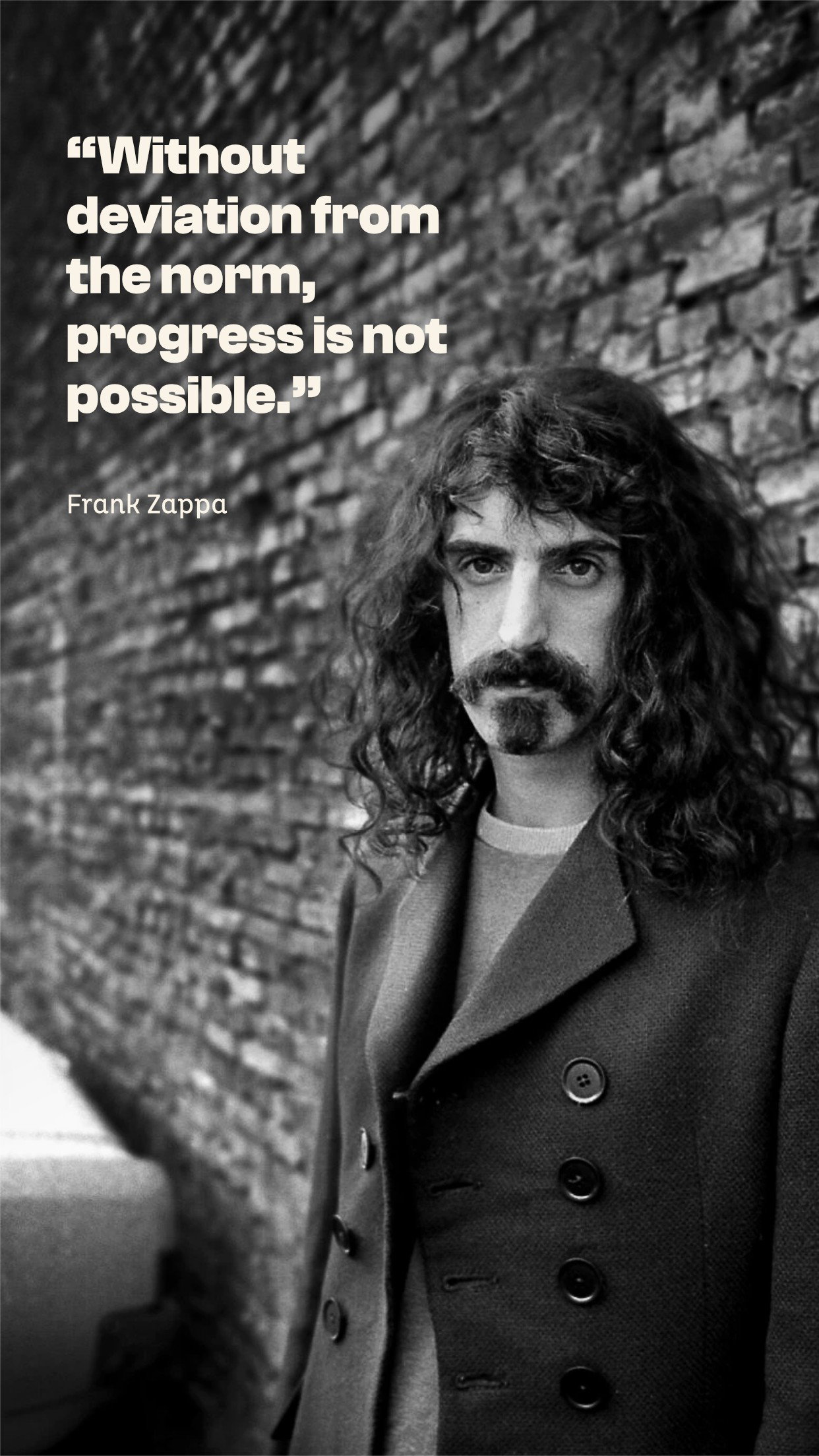
That's how you truly learn: reacting to a real need with a specific purpose.
Studying out of necessity allows you to absorb knowledge deeply and avoid the blockage caused by too much information and fear of failure.
This type of study is highly conscious and will stick with you because it's a vital experience. You won't forget what you've learned because you become the lesson. You identify with what you've learned, like a "living book" in Fahrenheit 451: you don't just memorize the idea —you embody it.
This is "embodying" knowledge, and it gives you a confidence that the academic method cannot offer. Instead of fearing error and freedom, learning from necessity strengthens your self-confidence.
If you study without an immediate need to apply what you've learned, it won't be effective: you'll forget nearly everything and have wasted time and energy, ending up blocked and overwhelmed.
Learning comes to life only when it is put into action. If you don't put into practice what you study, it remains just theory. Do something with what you know, even if you're not sure of the result.
This is crucial, so let it really sink in:
- Your training should be reactive, not preventive.
- Reactive training generates confidence; preventive training generates panic.
- Learn by doing. All at once. First badly, then better.
Third: Flow
Have the heart to love the process.
The third element involves learning to flow in the present. Over time, you'll be able to enter this state from the first step: action. It may sound like black magic now, but you'll master it with practice.
To flow is to deeply trust the process and forget about the results.
When you enjoy the process, this happens naturally. You don't have to force it or overthink it; it will simply happen, and when it does, you'll know it 100%.
When you flow, you lose track of time; you might even forget to eat. You've been there.
Although it sounds somewhat "New Age", it's true: flowing is being present in the here and now, setting aside intrusive thoughts about the future, about what others might think, about how it "should" turn out or look, who will see it, who will buy it...
All these thoughts are neuroses born from an imagined future, fueled by a fear of not meeting expectations you've imposed on yourself.
If you don't enjoy the process, you risk becoming a hypochondriacal, cowardly, neurotic, self-conscious, and frustrated artist. And nobody wants to be that kind of artist.
I can't ask you to stop having those thoughts overnight, but I can ask you not to take them seriously. That can be chosen consciously. It's not easy, but it's possible.
If you accept that you must first act without overthinking and then adapt to what arises, you've almost got it. You just need to love what you do and enjoy the process —not the result. This will happen naturally as you dedicate time and see some progress.
Like in sports: no one runs just to get someone; they run because they enjoy the act of running. The same happens with your art. You don't make art to get paintings; you do it because it fulfills you.
Regarding Error
A failure is an error tinged with guilt.
The idea of guilt is most certainly present in nearly everything we do. Guilt has a social function, but it's out of place as part of a creative process.
Errors during a creative process cannot be placed in the same category as personal and moral errors. They are not the same, and they must be clearly differentiated.
There are two things you must do:
- Remove error from the personal realm: Something you've done wrong and should regret and not repeat.
- Place error in the realm of the process: Error as a rectifiable result, as an indispensable part of the creative process.
Super Problem #1: Inviting Everyone
If we know too much, it could be because we lack sufficient criteria to discriminate information. We must be able to distinguish a sign from the noise.
Information in small doses is medicine; in high doses, poison.
It can be summed up like this: "Don't invite all your friends to the party." You only invite your closest friends, and you have your reasons. Why don't you do the same with ideas, teachers, methods, courses, and books?
More information is not more knowledge, but instead less clarity. If the information you consume doesn't bring you clarity, it's just confusing you.
It's true that knowledge takes up little space, yes, but it consumes a lot of energy and attention —two very precious resources in your brain and beyond.
That's why excess information is the main reason for many artists' blockages.
Super Problem #2: Treating the New as an Intruder
The ideas that live in our heads feel entitled to live forever in our attic, even if they don't pay rent. We once invited them to spend a weekend, and they settled in, taking full advantage of our familiarity.
They resist departing and change the locks to protect themselves from fresh ideas, which they fear. They are squatters entrenched in our brains who insult new guests, spoiling our hospitality.
They must be evicted. These old ideas prioritize only survival, not usefulness. It's that simple, so it's up to you to decide what you're going to do with all this riffraff.
An old idea is distrustful and never gives up. And thus, what we know now is what prevents us from learning new things.
And the same happens with skills: old competencies don't easily give way to new aptitudes. So the challenge isn't so much about incorporating new ideas but detaching from old ones.
Humiliate them by inviting in more powerful, more beneficial, more convenient, more useful and more effective ideas. Simply put, make room. Clean the house. Take out the trash.
Having an open attitude puts us in better position for growth. Of course, being willing to change is the smartest thing we can do... But how difficult it is to banish our prejudices!
We defend our opinions as if our life depended on it. These toxic ideas are part of our identity and result in the Stockholm Syndrome.
These ideas possess our minds to such an extent that, upon their removal, we are invaded by a terrible feeling of loss. We feel that by getting rid of old ideas and habits, we also lose a piece of our identity.
And that messes with us deeply.
It's especially painful for artists because learning something new requires suspending the ego and cultivating humility.
Learning is to learn to lower your ego. To stop being so "me." To stop prejudging everything systematically. To stop being inflexible.
To be artists from within, using our gray matter: creating, experimenting, moving things around, connecting unexpected dots, trying new techniques, different points of view.
Every new idea goes through a serious ordeal until it settles on a privileged balcony in our brain. Like a video game, the new idea fights to pass levels until facing the final monster guarding the castle. And guess what: we are that monster, and we're going to put up a fight.
No one has creative problems. No one has professional problems. All problems are personal.
Being open to change, to be less "me," to become the person capable of controlling these problems, is the most precious and alarmingly well-paid skill that exists on this planet.
Who Are You When No One Is Watching?
When you feel the sting of the impostor, ask yourself: Who is watching?
Maybe you're alone in your studio, and at first, the question seems silly to you. But if the feeling of being an impostor persists, it means someone is staring right at you.
Who is watching?
When you feel like a fraud, you feel it in relation to an external gaze. Someone is judging you from the outside.
Then you start to listen more carefully and dig up the culprits. It turns out there's always someone watching. Your teachers, your colleagues, your clients, your gallery owners, your partner, your family... Someone observing your actions and judging you.
Maybe someone from the past. Perhaps someone from the future. But never from the present, that dimension you no longer frequent so often.
So, who the hell is watching right now? Because you're alone.
Call me crazy, but maybe it's your arrogance that has given life to this scenario.
Maybe your vanity is what leads you to think and act as if you were in a talent show and you're being scored. Because deep down you want to be seen, compared, and rated. You long for recognition, medals, applause, money.
Ah yes, all that.
You say it doesn't matter, but you act as if it did, and a lot.
And in your desire to be loved and validated, you behave as if you were being watched at all times. That's every impostor's dream: to be observed, audited, rated and validated by an external authority. To transfer all responsibility and criteria off of oneself. And since none of this exists, you fabricate it.
How pleased with yourself you are.
And of course, faced with the relentless scrutiny of the terrifying judges you've invented, you feel like a fraud.
You feel so insignificant, humble, a fraud... Yeah, right. There's a lot of arrogance in acting as if you were being watched. A lot of vanity.
There's arrogance in not being worthy even of your own judges.
A tic deeply ingrained in your head. A virus that has infested you.
Your ego writes checks that your art can't cash.
Seen this way, it's no wonder you're taking it so badly.
Well, everything points to the fact that you've got a terrible setup for yourself, ha-ha.
Is there a solution?
There is a solution.
Let's see if we can disinfect you…
The Lonely Planet
In this mental experiment, I'll show you how to enter a mental state where you stop feeling like a fraud.
Let me propose a mental experiment. It's a visualization. Try to imagine what I'm telling you as vividly as possible. Let yourself into the story.
Imagine you're the last person on the planet. You're alone and have every building in the world, and every art shop, at your complete disposal and free of charge.
Time has stopped, and you're absolutely alone in the world.
Interestingly, you don't feel loneliness but liberation. At last, you're on your own. Finally, you're in the present. Finally, you exist. Finally, at peace.
Against all odds, you find it somehow comforting to be that last person.
You feel an energy come over you like you've never experienced before, a certainty that anything is possible and that there are no remaining obstacles.
For the first time, you experience the sensation that there's no pressure, that you're free to do whatever you please.
For the first time, you feel at peace and capable of anything.
And in this state of grace, you decide to be the last great artist on the planet.
Visualize how you set up an amazing studio with an abundance of materials of the very best quality. Free and plentiful —everything you could ever want. The entire world at your disposal.
You have all the time in the world, and no one will ever, ever see what you're going to paint. Nothing you do will remain for posterity because you're the last person left. After you, that's it.
Your art will disappear without ever having been seen, for only you to enjoy. Only you.
No one is going to correct or censor you. No one will criticize it or buy it from you. There's no reward, no criticism, nothing at all. There is no legacy.
You're alone in the world, in your studio, without needing to prove anything to anyone or show off in any way.
And you start painting. You paint just because —because you can. For the mere pleasure of it. Because there's nothing else to do in this empty world.
Art for art's sake.
Do you feel the tremendous liberation?
Here, there's no one who will judge you, criticize you, humiliate you, praise you, buy from you. No one will hate your art. No one will love your art.
Do you feel the liberation?
Visualize what you will do on this planet free of onlookers, laws, and judges.
Now you're before a blank canvas, and new sensations invade you. You feel like painting something different, you feel at peace, and you have a powerful vision.
You start painting; you know where you're headed, and you feel unashamed. Everything flows, and there's a powerful sacred energy in the air.
What you do matters. It's transcendent. It's unique. You feel the enormous power of the freedom at your fingertips.
Stay in your studio, painting. Try to stay there as long as possible and observe what happens. Visualize it and engrave it in your memory. Write down the ideas that come to you; make sketches. Hold onto what was going through your mind on the lonely planet because that's exactly what you should be doing on this planet, full of onlookers, laws, and judges.
Remember the energy, and try to project it here and now. And ignore the noise.
Remember the empty planet, indifferent to your art.
Return to your lonely planet, where none of that exists.
Aim to remember the path and create from where no one is watching you. If you manage to release this fantasy of behaving in private as if you were in a public contest, you'll see that the Impostor Syndrome disappears.
Make art as if no one was watching you.
And when someone really does look at you, they'll be amazed. They won't believe their eyes. No matter how good you are, how amateur you are, whatever technique you're lacking...
If you manage to make art as if no one was watching —as if you were on the lonely planet— I promise you'll connect with someone. And that person will say, "I love your art."
And what will you do when you hear it?
For the love of God, don't ruin this magical moment, and follow the instructions I give you below EXACTLY.
Instructions on How Not to Blunder a Compliment
This is very simple but still more powerful. It never fails; you'll see.
Here we go.
The next time someone tells you, "I love your art…"
Even if it seems like rubbish to you. Even if inside you only have excuses, apologies, objections, and "it's not that great," shut your trap. Really, shut your mouth for once.
You have no right to disrespect the person who is trying to connect with you.
Give them a chance.
Accept the connection. Respect those who connect with you. Let your hair down. Accept the connection; don't be rude.
Did you accept it?
Good. Now lift your head and say, loud and clear:
"THANK YOU"
And don't say another damn word.
That's perfect, unbeatable.
Look how good you look when you're quiet.
Do this always. Always. Always.
You'll see what a great liberation.
Two simple words... but what freedom.
The first time, you won't even believe it yourself. The fourth time, you'll say it out of habit. The eighth time, you'll believe it with all your soul.
Trust me; it works.
This is High Magic, medicine.
Just do it; it works.
And for the love of God, don't say anything else.
What will you do the next time you feel like an impostor?
Kiki & Bouba
Before the island, there's a part of it that fits in your studio.
Kiki & Bouba is a seven-week online experiment for visual artists. Seven experiments you do in your own studio, with your usual materials.
Technique gives your ideas form. Over the years, it also starts filtering them. Too clumsy. Too weird. Doesn't look like me.
Each experiment changes some of the rules, so your usual solutions can't solve everything. You keep everything you know.
It won't teach you how to paint, or show you a secret technique that would make Titian cry. No teachers, no corrections. You post what you made and how you decided it, and see how other artists solved the exact same problem.
It's the part of Quarantine that fits in your studio. €444, once. Lifetime access.
ENTER THE EXPERIMENT
Experiment 🎱
This guide was the perfume sample. This is the bottle: a Quarantine you attend in person, so you can stop being an invisible and harmless artist.
Experiment 🎱 · April 12–18, 2027 · Lazaretto of Menorca. Seven days on a quarantine island with up to 63 artists.
The mentors: Yulia Bas, Phil Hale, Soey Milk, Mu Pan, Tania Rivilis, Ben Spiers and Kent Williams.
They'll teach you to use ideas as if they were daggers. Not to fear fear. They'll teach you not to be docile.
It costs €3,700. 30% secures your spot, only if you're accepted.